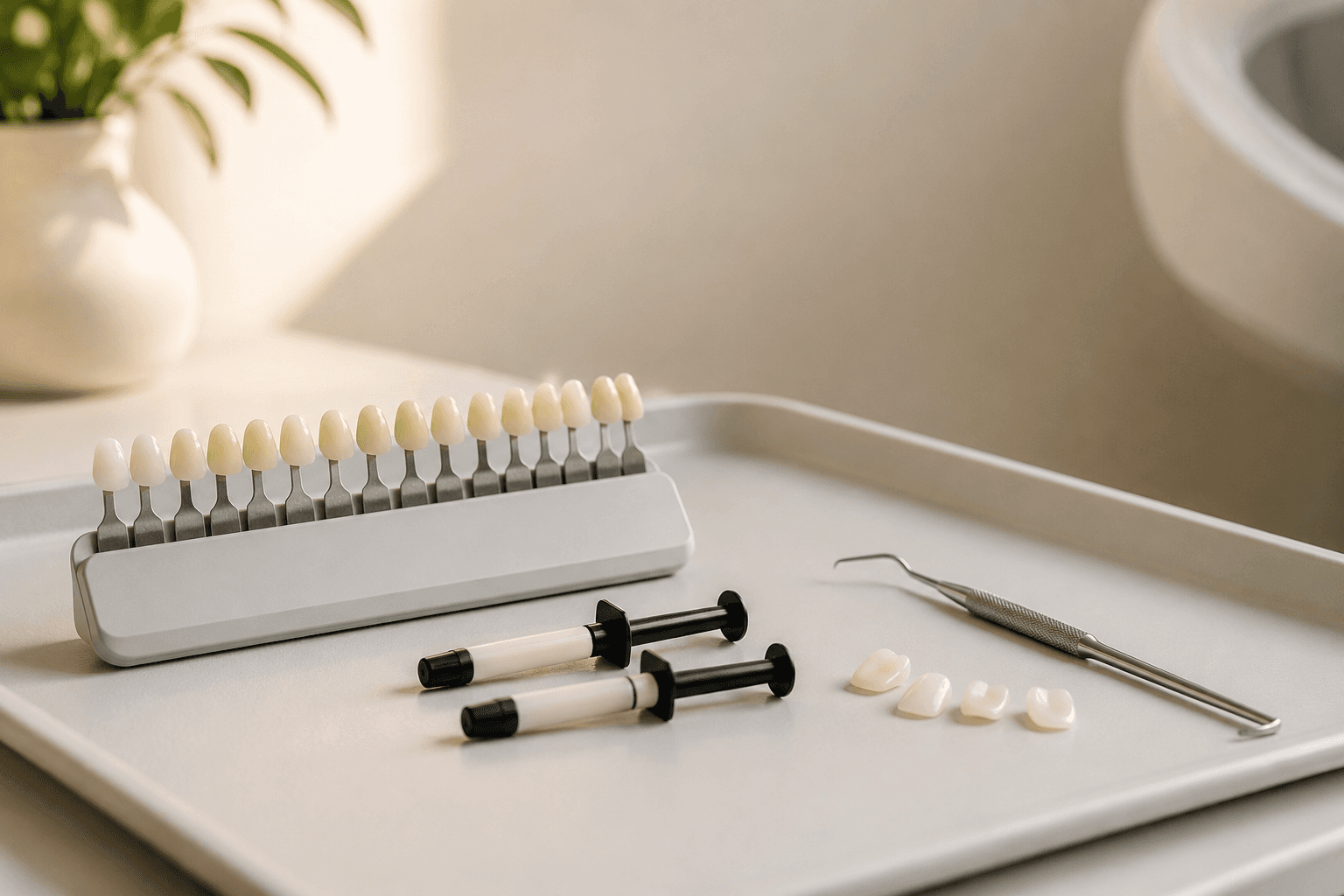
Veneers and bonding both improve the appearance of a tooth by adding material to the front surface. Bonding uses tooth-coloured composite, shaped by hand in the mouth in a single visit, and removes very little or no tooth structure. Veneers are thin layers of porcelain, made in a dental laboratory, and bonded onto the tooth after a small amount of enamel has been prepared away.
They are not interchangeable. Bonding is faster, cheaper, more conservative, and reversible. Veneers are more durable, hold their colour and surface better over years, and look closer to enamel under different lights, but they involve a more permanent change to the natural tooth. Choosing between them is mostly a question of how much you actually need to change.
At our Mohali clinic we tend to recommend bonding first when it can solve the problem, and veneers when bonding will not last or will not look right. We do not push the more permanent treatment when the simpler one will do.
When veneers or bonding are appropriate
Bonding is appropriate for small chips, small gaps, worn edges, surface defects in single teeth, and minor reshaping. It is also useful for patients in their teens and twenties whose teeth are still maturing and for whom a permanent change to the natural tooth would be premature.
Veneers are appropriate when several teeth need a coordinated change in shape or shade together, when bonding has been tried on the same tooth more than once and not held, or when the patient wants a result that will hold its surface and colour through years of use. They are also appropriate for selected single front teeth with significant discolouration that whitening will not lift.
When they can wait, and when they should not
Cosmetic work on the front teeth can almost always wait. There is no clinical urgency to a chipped edge or a small gap, and the time spent thinking about whether bonding or veneers is the right call is rarely wasted. For patients in their teens and twenties, waiting is often the right answer in itself; tooth shape and gumline keep adjusting through the early twenties.
What should not wait is decay or active gum disease underneath any cosmetic plan. A veneer over an unrestored cavity will fail. A new bonding repair on a tooth that is wearing because of a deeper bite issue will simply wear again. We will treat what is underneath before the cosmetic layer goes on top.
How we approach veneers and bonding at our Mohali clinic
We perform veneers and bonding in-house at our Mohali clinic. Both treatments start with photographs, a discussion of what you want to change, and an examination of the tooth and the surrounding teeth so the result will sit naturally with everything around it.
For bonding, we choose the composite shade and place it in layers, shaping it in the mouth until the contour and surface texture match the neighbouring teeth. The polish at the end is the part that takes the longest and is the part that makes it disappear into the smile.
For veneers, a small amount of enamel is prepared, an impression or a digital scan is taken, and a temporary veneer is fitted while the laboratory makes the final one. The final veneer is tried in before bonding so the shape, shade, and fit can all be confirmed in your mouth, in your face, with you in the mirror. We do not bond a veneer that is not right.
What to expect at your appointment
Bonding is usually one appointment, sixty to ninety minutes per tooth depending on the work involved. Veneers are usually two visits a week or two apart, plus a fitting check after the final bonding.
- For bonding: examination, shade selection, conservative preparation if any, layered placement of composite, shaping and polishing in the mouth, and a bite check.
- For veneers: examination, shade and shape planning, conservative tooth preparation, impression or scan, fitting of a temporary, laboratory work for the final veneer, try-in, bonding, and a bite check.
- A short follow-up a few weeks later to confirm the bite and the comfort of the new surface.
Sensitivity to cold for a day or two after veneer preparation is common and settles on its own. Bonding rarely causes sensitivity. Both treatments need normal cleaning at home; bonding is slightly more prone to picking up stain from tea, coffee, and turmeric than porcelain veneers are.
Common questions before treatment
The most common question is which one to choose. The honest answer is that it depends on the tooth and on how much change you actually want. For one small chip on an otherwise healthy front tooth, bonding is almost always the right answer. For a coordinated change across four or six front teeth that need to look the same shade and shape, veneers usually hold up better over years.
Patients ask whether veneers can fall off. A properly bonded porcelain veneer rarely comes off in normal use. The most common cause is a bite issue (grinding, an uneven bite, a habit of biting on hard objects). We assess the bite carefully before recommending veneers, and we may suggest a nightguard if grinding is part of the picture.
A third question is whether veneers can be removed. The veneer itself can be removed and replaced, but the small amount of enamel removed during preparation does not grow back. That is why we are conservative about how much enamel we take, and why bonding remains the first option whenever it can solve the problem.
A note on results that look natural
The teeth that look least natural after veneer work are usually the ones that are all exactly the same shape, exactly the same shade, and exactly the same length. Real front teeth are not uniform. The two central incisors are usually a fraction longer than the laterals, the canines carry a slightly different hue, and the surfaces catch light unevenly. A good veneer takes those small irregularities seriously instead of polishing them out.
We design veneers and bonding around the face, the lip line, and the way you actually smile, not around a chart. The aim is a result that the people closest to you would notice as "you look well", not as "you have had work done".
A note on cost and timelines
Cost depends on the number of teeth involved, the choice of bonding versus veneer, the porcelain or composite used, and any underlying work that needs to come first. We will give you a written estimate at the planning visit, with each tooth costed separately, so you can choose to do all of them at once or stage the work over time.
For NRI patients planning to combine veneer work with a visit home, please get in touch a few weeks before you travel. Veneers in particular need lab time, so a single short visit is rarely enough; we usually plan for two visits, with a temporary veneer in between if needed.