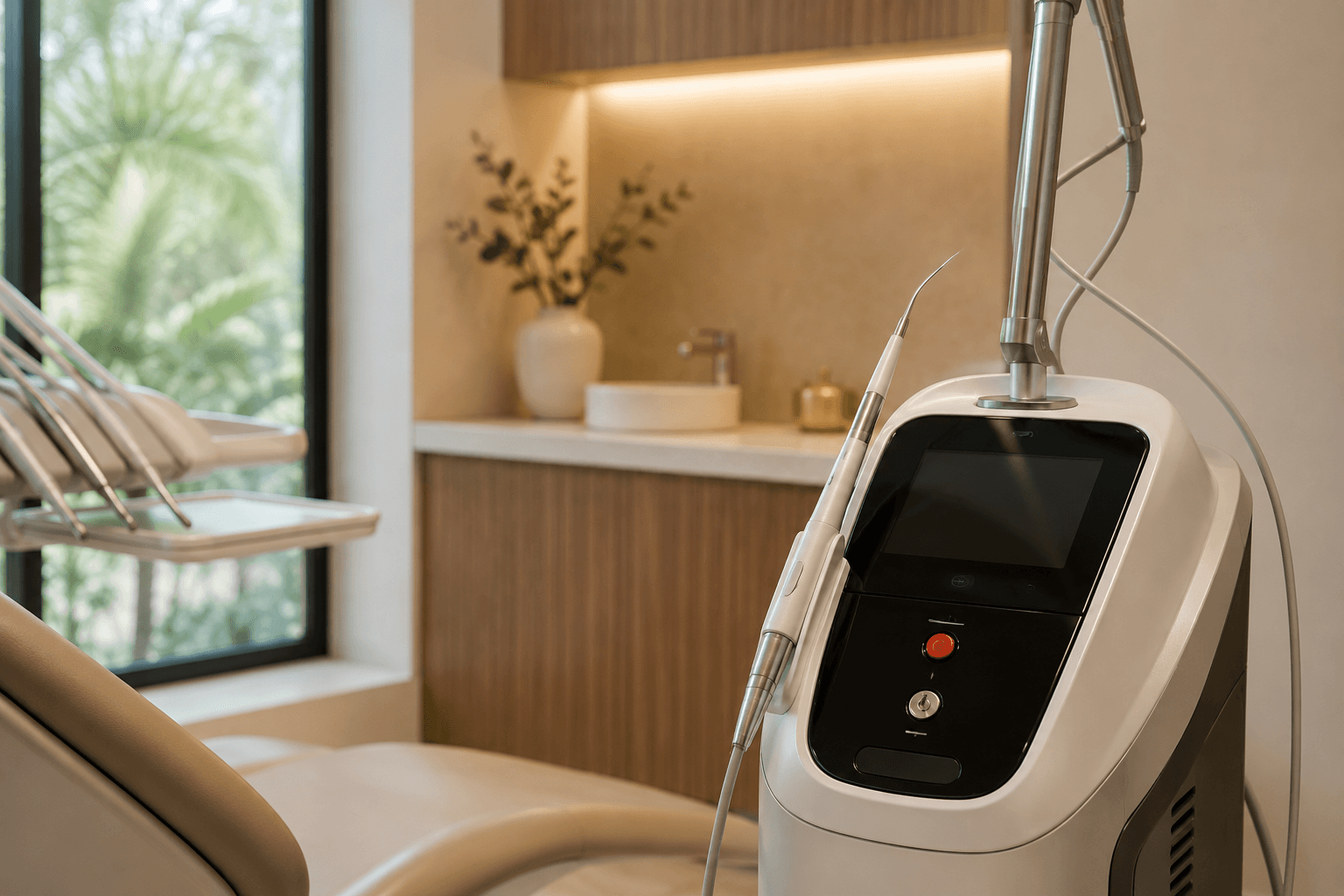
Dental lasers are a tool, not a marketing line. They use focused light to do specific jobs in the mouth: trim gum tissue, reduce bleeding during certain procedures, address some forms of gum disease, contour a gum line for cosmetic balance, and a small number of other targeted uses. They do not replace the rest of dentistry, and they are not better for every procedure simply because they are lasers.
We use lasers in our Mohali clinic where the laser genuinely gives a better result than the traditional approach. We do not use them as a default upgrade or as a way to justify a higher fee for a routine procedure. The choice between laser and traditional technique is made on the merits of the individual case.
Patients sometimes arrive expecting that a laser will make a procedure painless, faster, or dramatically different from traditional care. For some procedures it does help meaningfully. For many others, the difference is modest. Being honest about which case sits in which group is part of the work.
When a laser is useful
Lasers are most useful for soft-tissue work in the mouth: shaping the gum line for cosmetic reasons, removing small gum overgrowths, treating some forms of cold sores, and addressing inflamed tissue around an implant or in periodontal pockets. They reduce bleeding during these procedures, which makes the work easier to do precisely, and they often shorten healing time.
Lasers are also useful as part of certain periodontal protocols, where they help reduce bacterial load in the gum pockets between deep cleanings. For these uses the evidence is solid and the clinical benefit is real, particularly for patients with active gum disease.
When a laser is not the right tool
Lasers are not the right tool for most fillings, for crown preparation, or for the bulk of routine restorative dentistry. Traditional handpieces remain faster, more controllable, and more predictable for cutting hard tooth structure. A laser used on a cavity for marketing reasons rather than clinical reasons is not better dentistry; it is dentistry with extra steps.
Lasers are also not a substitute for the rest of the appointment. The careful diagnosis, the unhurried treatment, the honest conversation about what the tooth needs. None of that is replaced by the equipment. A laser in skilled hands, in the right case, is useful. A laser in marketing copy, applied to everything, is noise.
How we approach laser dentistry at our Mohali clinic
We perform laser dentistry in-house at our Mohali clinic, alongside the rest of our restorative and cosmetic work. The laser is one tool in the room; we use it when the procedure suits it and we use traditional technique when traditional technique is the right answer.
We will tell you in plain language when a laser is being recommended and why. If your case does not need a laser, we will say so and not add it to the bill for the sake of doing so. If your case does benefit from one, we will explain what the laser is doing differently from a traditional approach and what difference that is likely to make to your experience and your recovery.
What to expect at your appointment
Laser-assisted appointments are usually a similar length to traditional ones for the same procedure. The differences are in the details rather than in the overall feel of the visit.
- A discussion of why the laser is being used for your particular procedure.
- Local anaesthetic if the procedure normally needs it. Most soft-tissue laser work needs less anaesthetic than the equivalent traditional procedure, but some still need it.
- The laser-assisted work itself, with eye protection for both the patient and the team.
- Brief written aftercare appropriate to the procedure, often with a shorter healing window than the equivalent traditional approach.
Discomfort during laser-assisted soft-tissue work is usually mild. Bleeding during and after the procedure is often reduced. Healing for soft-tissue work tends to be quicker than after traditional surgical approaches. None of this makes the procedure magic; it makes the recovery a little easier.
Common questions before treatment
Patients ask whether laser dentistry is painless. It is often less uncomfortable than the equivalent traditional procedure for the right cases, but it is not painless across the board. Procedures involving deeper tissue work or hard tooth structure still need anaesthetic and still involve sensation. The marketing line that lasers are entirely painless is not honest.
Patients ask whether laser work costs more. For some procedures it does, because of the equipment cost and the training involved. For others the cost is similar to the traditional alternative. We give a written estimate before any procedure, and we will explain the difference between the laser-assisted fee and the traditional fee so the decision is yours.
A third common question is whether all dental clinics have lasers. Many do not, and many that do use them only for specific procedures. The presence or absence of a laser is not, by itself, a useful marker of quality. The right question to ask any clinic is not whether they have a laser, but how they decide when to use one.
A note on cost and timelines
Cost depends on the procedure, on whether the laser is the primary tool or a supporting one, and on any related treatment the same visit covers. A short cosmetic gum contouring is a different conversation, in cost and in time, from a course of laser-assisted periodontal therapy. We will give you a written estimate before any work is begun.
For patients travelling from abroad and considering laser-assisted treatment as part of a visit home, please get in touch a few weeks ahead with the specific procedure in mind. We can confirm whether the laser is the right tool for your case before you book the trip.