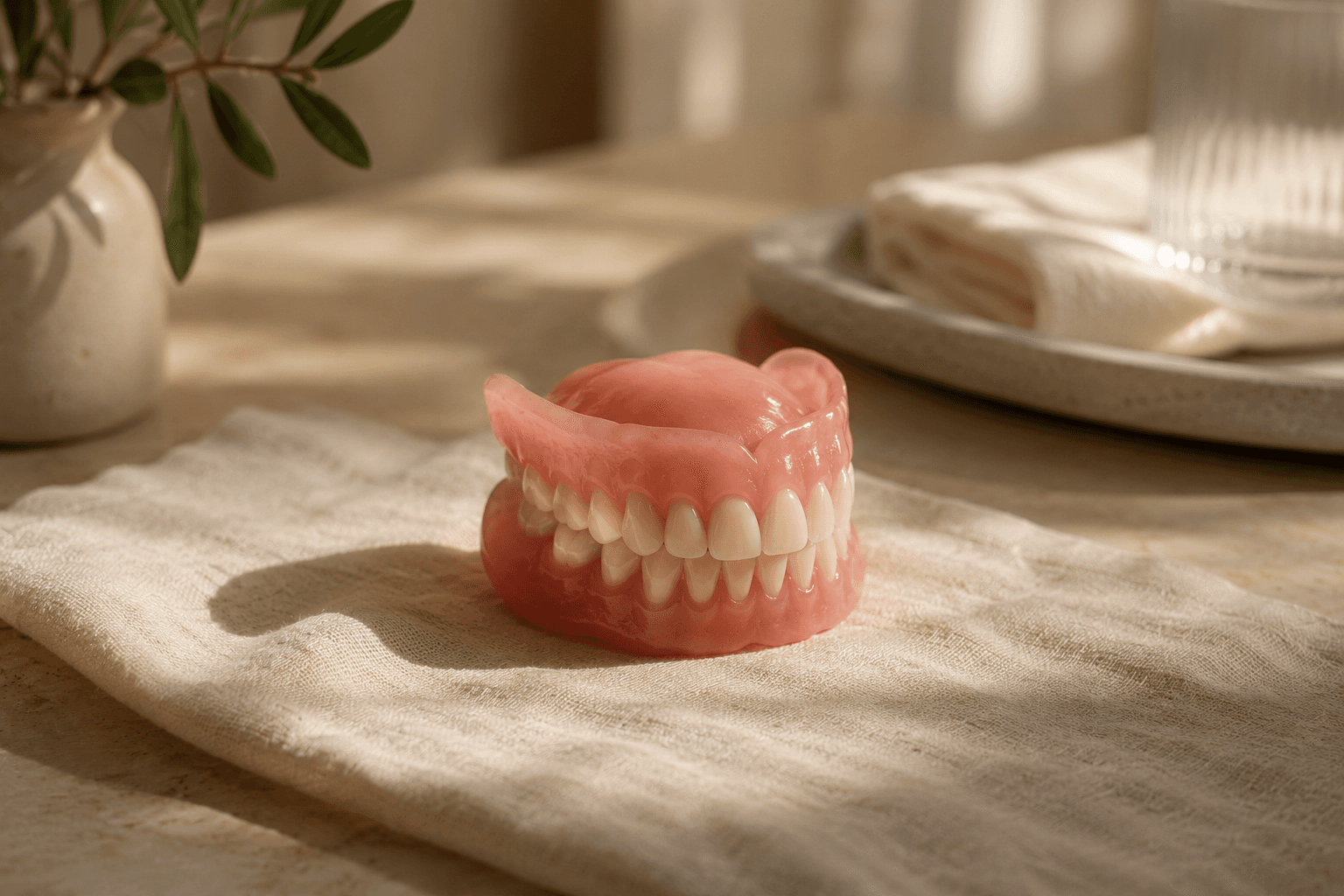
A denture replaces missing teeth with a removable appliance. A complete denture replaces all the teeth in an arch (upper, lower, or both), and a partial denture replaces several missing teeth while clasping onto the remaining natural ones. Dentures are still made today for the same reason they have been made for decades: because they let people who have lost teeth eat, speak, and smile again, at a cost and complexity that other options sometimes cannot match.
Modern dentures are better than the ones older patients remember. The materials are lighter and more comfortable, the impressions are more accurate, and the fit on a well-made denture is closer than it used to be. They are still not the same as natural teeth, and they ask for a real adjustment period from the patient, but they remain a sensible answer for many cases.
At our Mohali clinic we have been making dentures since the practice opened in 1997. We treat them as careful, individual work, fitted to each patient over several visits, not as an off-the-shelf product.
When a denture is the right choice
A complete denture is the right choice for a patient who has lost all the teeth in an arch, has insufficient bone for All-on-4 or full implant work, or has chosen denture treatment for medical, financial, or personal reasons. A partial denture is the right choice for a patient who has several missing teeth, healthy remaining teeth that can act as anchors, and wants a removable solution rather than a bridge or implants.
A denture is also a sensible interim solution. Patients waiting for implants, or for bone to heal after extractions, often wear a transitional denture in the meantime. The interim solution does not need to feel permanent to do its job.
When it can wait, and when it should not
Replacing missing teeth is rarely medically urgent in the first weeks. The gum and bone settle better when they are given time after an extraction. A few weeks to a few months between the last extraction and a final denture usually produces a better-fitting result than rushing one in the same week.
What should not be ignored is the long-term cost of going without teeth in an arch. The bite shifts. The remaining teeth tilt or over-erupt into the space. The face changes shape as the bone resorbs. The longer the gap is left, the more limited the eventual options become. If you are between extractions and a decision about a denture, please make the decision; do not let the question drift for years.
How we approach dentures at our Mohali clinic
We perform denture work in-house at our Mohali clinic. A standard denture pathway takes four to six appointments over four to six weeks, depending on the case. We do not compress the sequence into one or two visits; the impressions, the bite registration, and the try-in are the parts that decide whether the denture fits well, and each of them is its own appointment for a reason.
For patients considering implant-retained dentures (the type that clip onto two or four implants in the lower arch in particular), Dr Aman coordinates with visiting implant surgeons who treat patients here at the clinic. An implant-retained denture is a different conversation from a standard denture, and the planning needs the surgical opinion in the room.
Cheap "instant dentures" sold elsewhere are usually a false economy. The fit is approximate, the bite is rarely checked properly, and the patient often ends up returning to a careful clinic for a remake within a year. We would rather take the four to six weeks once than rebuild the same denture twice.
What to expect across the treatment
A standard complete or partial denture takes four to six appointments. Each is short.
- A planning visit with examination, photographs, and a written plan.
- Preliminary impressions, used by the laboratory to make individual trays for the next stage.
- Final impressions in the custom trays, taken carefully to capture the gum and the bone underneath.
- A bite registration appointment, where the upper and lower jaw relationship is recorded.
- A wax try-in of the denture, where the teeth are set on a wax base so the bite, the look, and the lip support can all be checked before the laboratory finishes the work.
- Fitting of the final denture, with adjustments to the bite and to any pressure spots felt in the gums.
- Follow-up review visits in the first few weeks for further adjustments as you wear it in.
A new denture asks for an adjustment period. Speech feels slightly different at first, certain foods are harder to eat for the first weeks, and pressure spots are common in the early days. These are normal and adjustable. Most patients are comfortable within a month and forget the denture is there within a few months.
Common questions before treatment
Patients ask whether dentures can stay in for eating normally. They can. A well-made denture, fitted carefully, lets most patients eat a normal diet, with the exception of very hard or very sticky foods on a lower complete denture. The lower complete denture is the hardest to keep stable, which is why implant-retained options are often discussed at that stage.
Patients ask how long a denture lasts. The denture itself usually lasts five to ten years before the surface wear or a change in the underlying gum makes a remake sensible. Relining (where the inner surface is refreshed without making a new denture) can extend that interval in many cases.
A third common question is how dentures should be cleaned. Out of the mouth, with a soft brush and a non-abrasive cleaner, and stored in water or a denture solution overnight. The natural teeth that remain (in a partial denture case) need careful brushing because plaque collects around the metal or acrylic edges.
A note on cost and timelines
Cost depends on whether the denture is complete or partial, on the materials chosen, and on whether implant support is being added. We will give you a written estimate at the planning visit, with each stage costed separately. A standard denture and an implant-retained denture are different orders of magnitude.
For NRI patients planning a denture around a visit home, the four-to-six-week sequence can sometimes be compressed if you can be in Mohali for that period; otherwise we plan across two visits, with the laboratory work done in between. Please get in touch a few weeks before you travel so we can hold the sequence of slots.