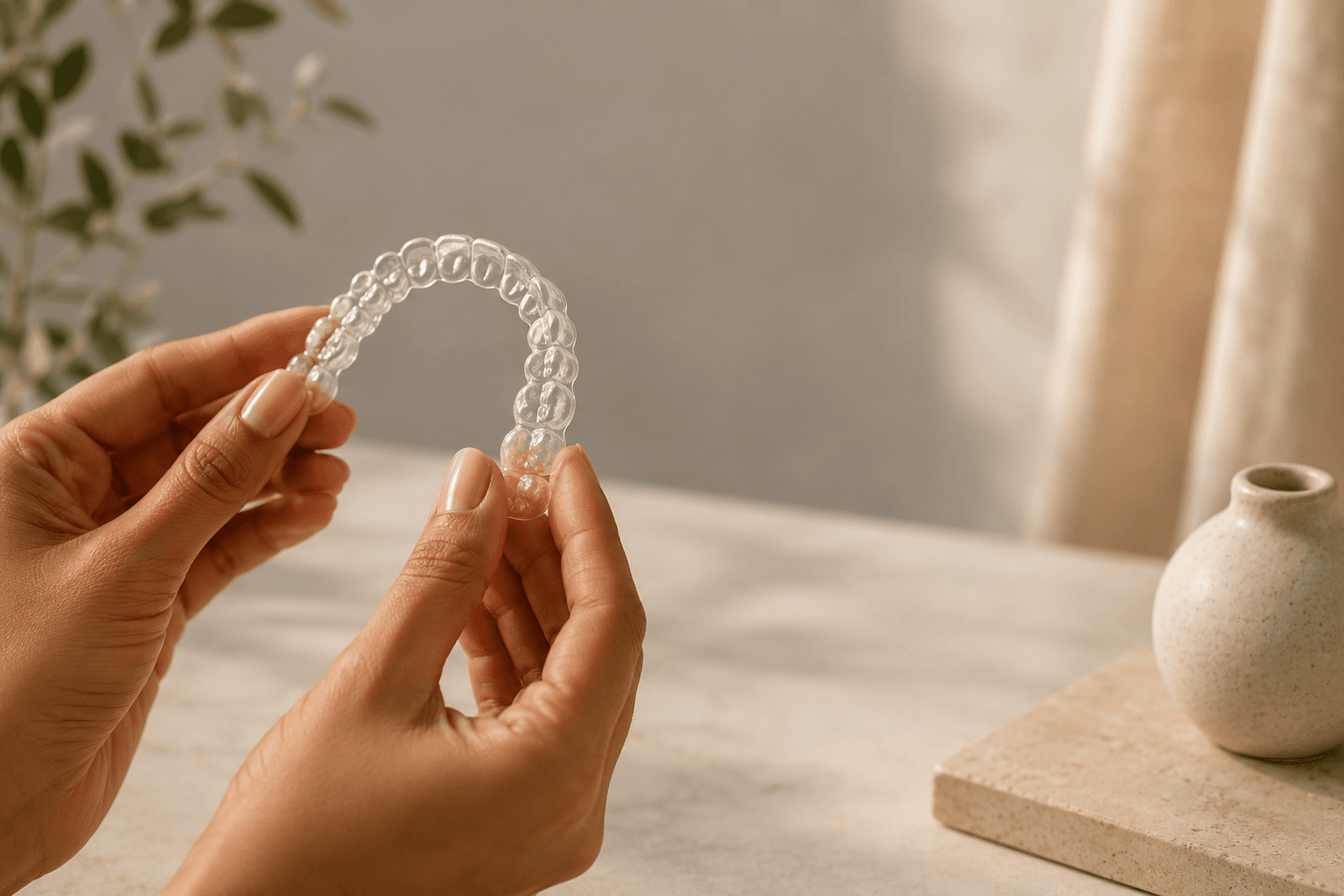
Clear aligners are a series of removable plastic trays, custom-made for your teeth, worn in sequence to move the teeth gradually into a planned position. Invisalign is the most widely known brand of the technique, but the principle is the same across the major systems: small adjustments over many weeks, with each new tray pushing the teeth a little further from where they were.
Aligners are not better or worse than braces. They are a different tool, suited to different cases. For mild to moderate misalignment, in a patient who can keep the trays in for twenty to twenty-two hours a day, they work well and are nearly invisible in normal use. For severe cases, complex bite issues, or patients who will not wear them as instructed, traditional braces are usually a better answer.
At our Mohali clinic we plan clear-aligner treatment carefully and tell you honestly whether your case suits aligners or braces. We do not start aligner treatment on a case that we know will end up in braces anyway.
When clear aligners are the right choice
Clear aligners are appropriate for mild to moderate crowding, mild spacing, mild rotations, and selected bite corrections, in patients who are disciplined about wearing them. They are particularly well suited to adults who want to align their teeth without visible orthodontic hardware: working professionals, patients who want their teeth straightened before a wedding or a milestone, and patients who have already had braces in the past and want a minor touch-up.
They are also useful for selected teenage cases, but only when the patient is genuinely committed to keeping the trays in for the required hours each day. A teenager who will not wear them is no different from an adult who will not wear them, and the result of either is no movement.
When they are not the right choice
Clear aligners are not the right choice for severe crowding, complex bite corrections, large rotations, or cases that need teeth to move significantly through bone in directions that aligners do not handle well. They are also not the right choice for patients who know they will not wear them faithfully; ten hours a day, instead of twenty-two, will produce a much slower and less predictable result.
Some growing children benefit more from traditional braces, and some bite problems are better addressed during a growth spurt with appliances that aligners cannot replicate. We will tell you if your case sits in this group, even if you came in asking for aligners. Recommending the wrong tool, just because the patient asked for it by name, would be a poor reason to begin.
How we approach clear-aligner treatment at our Mohali clinic
We perform clear-aligner planning and treatment in-house at our Mohali clinic. The first visit is a planning visit: photographs, a scan or impressions of the teeth, a discussion of what you want to change, and a written plan that includes the likely number of trays, the duration, and what the end position is expected to look like.
For complex cases that benefit from specialist input, Dr Aman coordinates with visiting orthodontists who treat patients here at the clinic. A second pair of eyes during planning helps decide whether aligners are the right tool, or whether braces would do the job better, or whether the case sits in the grey area where both could work.
Once the plan is set, you collect your trays in batches and wear them in sequence. We see you every six to eight weeks to check progress and hand over the next set. Most cases also use small tooth-coloured attachments bonded onto a few teeth to help the trays grip and move the teeth as planned; these are removed at the end of treatment.
What to expect across the treatment
A typical clear-aligner case runs from six months to eighteen months, depending on the complexity. Most appointments are short.
- A planning visit with examination, photographs, and a scan or impressions.
- Bonding of any attachments needed to help the trays grip the teeth.
- Wearing each tray for one to two weeks before moving to the next, twenty to twenty-two hours a day, removing them only to eat and brush.
- A check-up every six to eight weeks to confirm the teeth are moving as planned and to collect the next batch of trays.
- A final review at the end of the active treatment, with refinements if any teeth have not moved exactly to plan.
- Retainers, worn long-term, to hold the result. Teeth move back toward their original position if nothing holds them; this is true for braces and aligners alike.
Mild tenderness for a day or two each time a new tray is fitted is normal. Speech can feel slightly different for the first few days; most patients adapt within a week. Aligners need to be cleaned daily and stored in their case when they are out of the mouth.
Common questions before treatment
Patients often ask whether aligners are as good as braces. For the cases they suit, yes; the end position is set by the plan, not by the appliance. For cases they do not suit, no. The honest answer depends on your case, not on the brand of the system. We will tell you which group your case sits in.
Patients ask whether they can eat with the trays in. They cannot. The trays come out for meals and for any drink other than water, and the teeth are brushed before the trays go back in. This is one of the practical reasons aligners do not suit every adult; it is real discipline several times a day.
A third common question is what happens if a tray is lost. It is not a crisis. The usual answer is to move to the next tray earlier or to step back to the previous one until a replacement is made. We would rather you call us than leave the trays out for several days.
A note on results that look natural
A good orthodontic result is not necessarily the most uniform set of teeth in the textbook. The end position should suit the face, the lip line, the smile, and the bite. We plan toward a position that looks settled in your face, not toward a chart of ideal numbers. For patients whose original misalignment was mild, the change should be a quiet improvement that close family notice over weeks, not a dramatic before-and-after.
Retention matters more than people expect. Teeth do not stay where they were moved unless they are held there. We discuss the retainer routine at the planning visit, so it is not a surprise at the end.
A note on cost and timelines
Cost depends on the complexity of the case (the number of trays, whether refinements are needed at the end, whether retainers are included up front), and on the clear-aligner system chosen. We will give you a written estimate at the planning visit. A simple case and a complex case can differ by a factor of two.
For NRI patients considering clear-aligner treatment around visits home, the planning can usually be done on one visit, with trays collected in bulk for the period you will be away. Check-up scans can sometimes be done remotely, although we prefer to see you in person at the half-way mark if your travel allows.