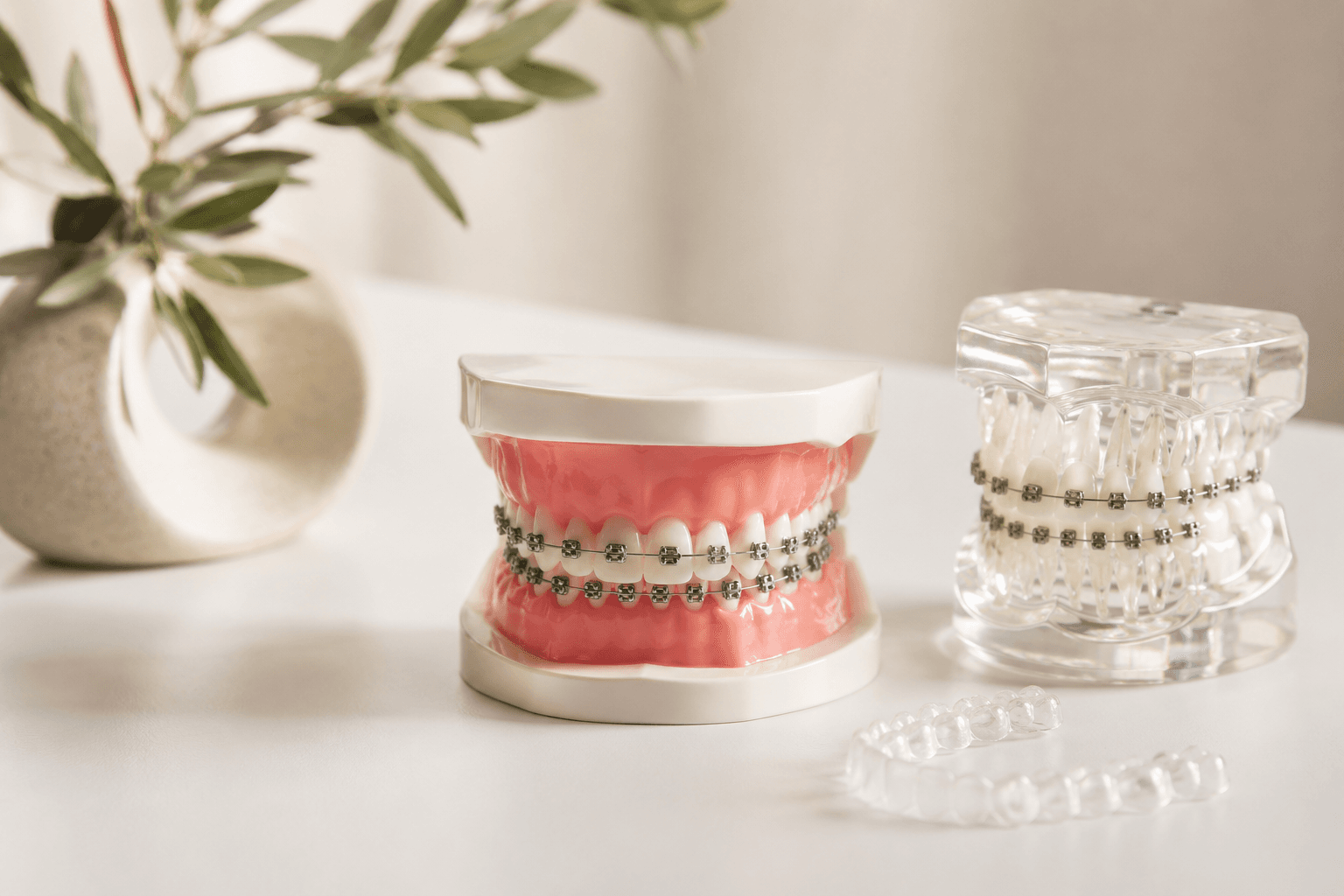
Dental braces are small brackets bonded onto the teeth and connected by an archwire, which is adjusted at intervals to move the teeth into a planned position. The technique is decades old, the science is well understood, and for many cases it remains the most predictable way to correct misalignment, crowding, spacing, and bite problems.
Modern braces are smaller and less obvious than the ones older patients remember from their own teenage years. Ceramic options reduce the visual impact further for adults who would rather not wear metal. The discipline of treatment, the duration, and the result are not very different from the discipline, duration, and result of an earlier generation; the visible difference has improved more than the underlying mechanics.
At our Mohali clinic we recommend braces when braces are the right tool for the case, and clear aligners when aligners are. We do not have a default. The plan follows the teeth, not a preference.
When braces are the right choice
Braces are usually the right choice for severe crowding, complex bite corrections, large rotations, and cases where teeth need precise three-dimensional control through bone. They are also often the right choice for paediatric patients who are still growing, where the orthodontic plan and the growth pattern have to work together.
They are a sensible choice for patients who know they would not wear clear aligners faithfully. Braces work twenty-four hours a day whether the patient remembers them or not, which is part of their reliability.
When they can wait, and when they should not
Most adult orthodontic decisions can wait. There is rarely medical urgency in tooth alignment, and an adult choosing between braces and aligners can take weeks or months to decide without harm to the eventual result.
Paediatric and adolescent cases are different. Some bite issues are best addressed during a growth window, and waiting past it makes the eventual treatment longer or, in some cases, surgical. If we identify a case in a child that has a window, we will tell you what the window is and why it matters. Waiting is not always the safe option in growing patients.
How we approach braces at our Mohali clinic
We perform braces planning and treatment in-house at our Mohali clinic. The first visit is a planning visit: photographs, an examination of the bite and the teeth, X-rays as needed, and a written plan that includes the type of braces, the likely duration, the appointment schedule, and the expected end position.
For complex cases that benefit from specialist input, Dr Aman coordinates with visiting orthodontists who treat patients here at the clinic. Full braces cases, paediatric cases with growth modification, and adult cases with bite issues that need a second pair of eyes are routinely run with the orthodontist involved at the planning stage and at key reviews.
Once the plan is set, the brackets are bonded and the first wire fitted in a single appointment of an hour or two. From then on, the appointments are short: a wire change or an adjustment every four to six weeks, with the occasional longer visit when a change in the plan is needed.
What to expect across the treatment
A typical braces case runs between one and three years, depending on the complexity. Most individual appointments are short and routine.
- A planning visit with examination, photographs, X-rays, and a written treatment plan.
- Bonding of the brackets and fitting of the first archwire in a single appointment.
- Adjustments every four to six weeks. Each adjustment takes twenty to thirty minutes.
- Occasional unscheduled visits if a bracket comes loose or a wire end starts to irritate; these are usually quick fixes.
- Removal of the braces at the end of active treatment, followed by polishing.
- Retainers, fitted on the day the braces come off or shortly after, worn long-term to hold the result.
Some discomfort in the first few days after the braces are fitted, and for a day or two after each adjustment, is normal. The cheeks and lips adjust to the brackets within a week or two. Cleaning takes longer than usual and the routine we teach at the fitting appointment is the single biggest predictor of how the teeth look at the end of treatment.
Common questions before treatment
Patients ask whether adults can have braces. They can, and many do. The biology of tooth movement is similar in adults and adolescents, although treatment is sometimes a little slower in adults because bone responds at a different rate. The cosmetic concern about visible metal is usually addressed with ceramic brackets.
Patients ask whether braces will hurt. The first few days after fitting and the first day after each adjustment are uncomfortable for most patients but rarely sharply painful. Most adults manage without anything stronger than ordinary pain relief.
A third common question is why we sometimes recommend braces over clear aligners. Some cases simply move better with the precise three-dimensional control that brackets and wires give. We will explain which features of your case shaped the recommendation, and we will not push braces on a case that aligners would handle equally well.
A note on results that look natural
A good orthodontic outcome is the position that suits your bite and your face, not the textbook ideal. We aim for teeth that meet evenly, sit comfortably under the lip line, and look settled when you speak and smile. Pushing every case to the same arch shape would not respect the variation between faces.
Retention is half the result. Teeth move back toward their original position unless they are held there, and so the retainer routine we set out at the end of treatment is not optional. Patients who keep the retainer protocol still have straight teeth at thirty-year follow-up; patients who stop wearing it after the first year often see drift within five.
A note on cost and timelines
Cost depends on the type of brackets (metal or ceramic), the complexity of the case, and the expected duration of treatment. We will give you a written, staged estimate at the planning visit so you know what each phase of the work involves.
For NRI patients considering braces, the practical issue is the frequency of in-person adjustments. We will plan around a realistic schedule and, where possible, coordinate with a colleague at your usual location for the in-between visits. We will be direct if a case is not well suited to long-distance management.