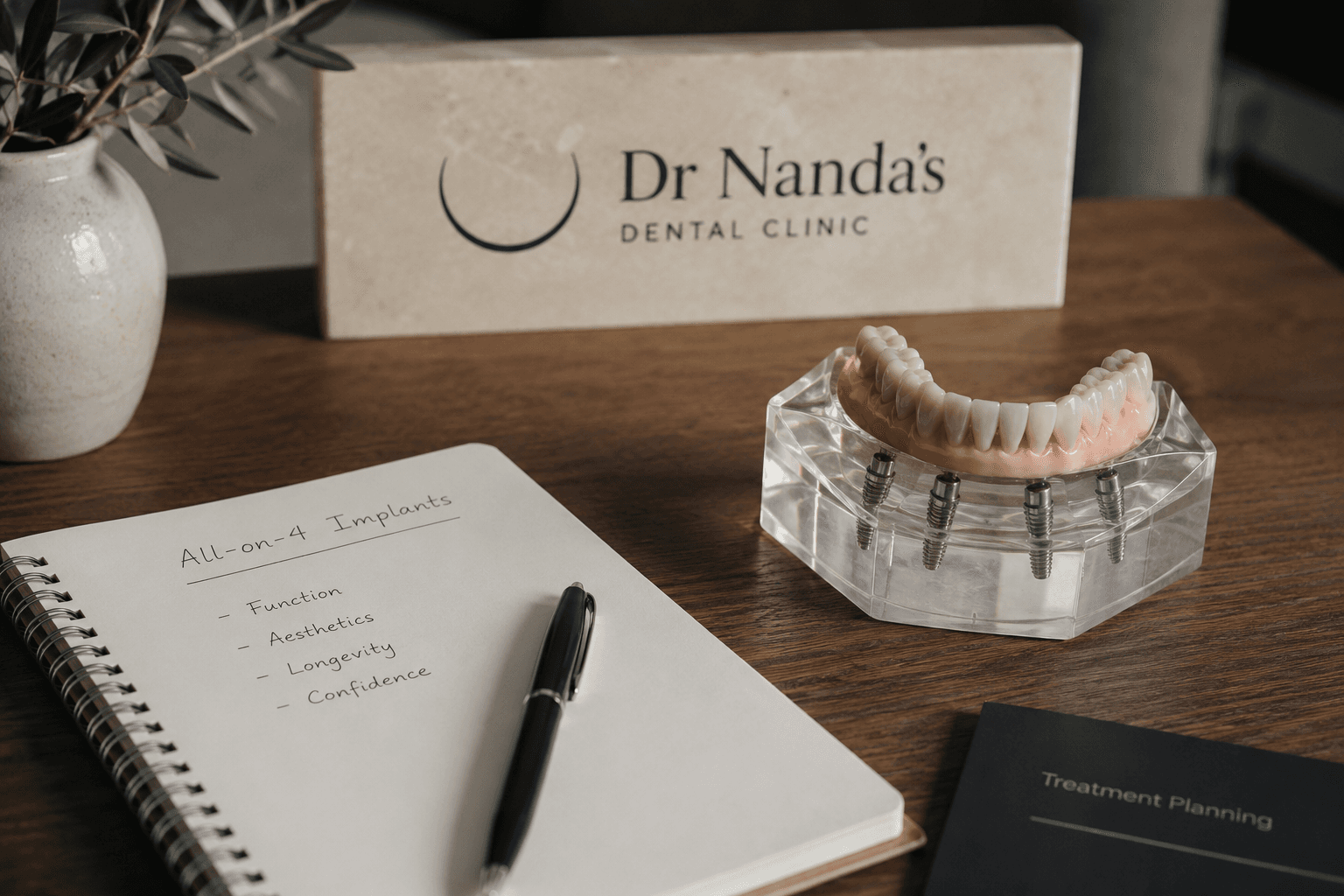
All-on-4 is a way of replacing all the teeth in an arch (upper, lower, or both) on a fixed set of four to six implants. The implants are placed into the available bone, a bridge of teeth is attached, and the patient leaves with fixed teeth that look and function much like a natural set. The result is fixed, not removable, and feels closer to natural teeth than a denture does.
The technique was developed for patients who have lost most or all of their teeth and who would otherwise be facing full dentures, or who already wear dentures and find them difficult to live with. It is well established, the science is sound, and for the right patient it can change how they eat, speak, and feel about their face.
At our Mohali clinic we approach All-on-4 carefully and never quickly. Most of these cases are stitched together across two or three appointments over a few months, and for patients flying in from abroad we plan the visits around their travel dates rather than the other way around.
When All-on-4 is the right choice
All-on-4 is usually the right choice for a patient who has already lost most of their teeth, or whose remaining teeth are not worth keeping (heavy decay, advanced gum disease, repeated failures of crowns and bridges), and who wants a fixed set of teeth rather than a removable denture. It is also a reasonable option for a patient who has worn dentures for years and finds the lower one in particular hard to keep stable.
The candidate must have enough bone to anchor the four implants, or enough bone to graft to. We assess this with a CBCT scan during the planning visit. If bone is severely reduced, the plan may shift to All-on-6, or to a different sequence entirely. We will tell you what your case can actually support.
When it is not the right choice, or can wait
All-on-4 is not the right choice when there are still enough healthy natural teeth worth saving, when a smaller bridge or a few single implants would do the job, or when a removable implant-retained denture (the kind that clips onto two or four implants) would suit the patient better. We will not extract good teeth in order to do a more impressive procedure.
It can also wait. The medical urgency to replace missing teeth is rarely a matter of weeks. If you are between full dentures and All-on-4 and weighing the decision, that thinking time is well spent, not wasted. Bone changes slowly in most adults, and a thorough planning visit gives you a better answer than a quick yes.
How we approach All-on-4 at our Mohali clinic
We perform All-on-4 in-house at our Mohali clinic. The first appointment is a long one: a full clinical examination, a CBCT scan, photographs, a review of your medical history, a discussion of what you currently eat and what you would like to eat again, and a written plan with the implant system named and the stages costed.
For complex cases that benefit from specialist input, Dr Aman coordinates with visiting implant surgeons and prosthodontists who treat patients here at the clinic. Full-arch work usually benefits from a second pair of eyes during planning, so this is a routine part of how we run these cases. You meet the specialist in the same chair you were assessed in, and your file does not move.
We use implant systems with long-term clinical data and components that will still be repairable in twenty years. We do not use the cheapest available implants on full-arch work. The implant has to outlast the bridge sitting on it, and the bridge will need maintenance at some point.
What to expect across the treatment
A typical All-on-4 pathway runs over three to six months from the first surgery to the final bridge. Most individual visits are shorter than people imagine.
- A planning visit with examination, scans, photographs, and a written treatment plan.
- Extractions of any remaining unsalvageable teeth, sometimes on the day of implant placement, sometimes earlier so the gum can settle.
- Placement of the four to six implants under local anaesthetic, often combined with a temporary fixed bridge fitted the same day or within a few days.
- A healing period of three to four months while the implants integrate with the bone. You wear the temporary teeth during this time and we see you briefly for checks.
- Impressions or a digital scan for the final bridge, with a try-in to confirm the bite, the shade, and the look in the face.
- Fitting of the final bridge, with adjustments to the bite so it sits exactly right.
Discomfort after the placement surgery is real for a few days and settles with ordinary pain relief. Swelling and bruising can happen and are not a sign that anything is wrong. Soft food for two to three weeks, no smoking during healing, and the cleaning routine we teach at the temporary-bridge fitting are the main things we ask of you.
Common questions before treatment
Patients often ask whether All-on-4 can really be done in one trip if they are flying in. For most planned cases the answer is no, and we are direct about that. The implants need time to heal between placement and the final bridge. The honest two-trip plan is: placement and temporary bridge on the first visit, final bridge on the next visit three to four months later. We will coordinate with your dentist at home if that helps in between.
Patients also ask about the "teeth in a day" advertising they have seen elsewhere. A temporary fixed bridge on the day of surgery is genuinely possible for many patients. The bridge fitted that day is, however, a temporary one. The final bridge follows after healing, and the longevity of the whole result depends on that staged work, not on what was screwed in on day one.
A third common question is whether the final teeth will feel like natural teeth. They feel close, but not identical. The bite force is restored, the appearance can be very natural, and most patients eat normally within weeks. The slight difference (no sensation through the tooth itself, since there is no nerve) is something most patients adapt to quickly.
A note on cost and timelines
All-on-4 is a significant investment, and we will give you a written, staged plan before any surgery is booked. Cost depends on the implant system, the number of implants (four versus six), whether bone grafting or sinus lift work is needed, the material of the final bridge (acrylic, zirconia, ceramic), and whether the case is upper, lower, or both arches.
For NRI patients planning treatment across two trips, the earlier you tell us your travel dates the better. We will plan the placement on the first visit so the healing window aligns with your next return. A short consultation by video call, with X-rays sent in advance, helps the in-person visit start from a position of clarity.