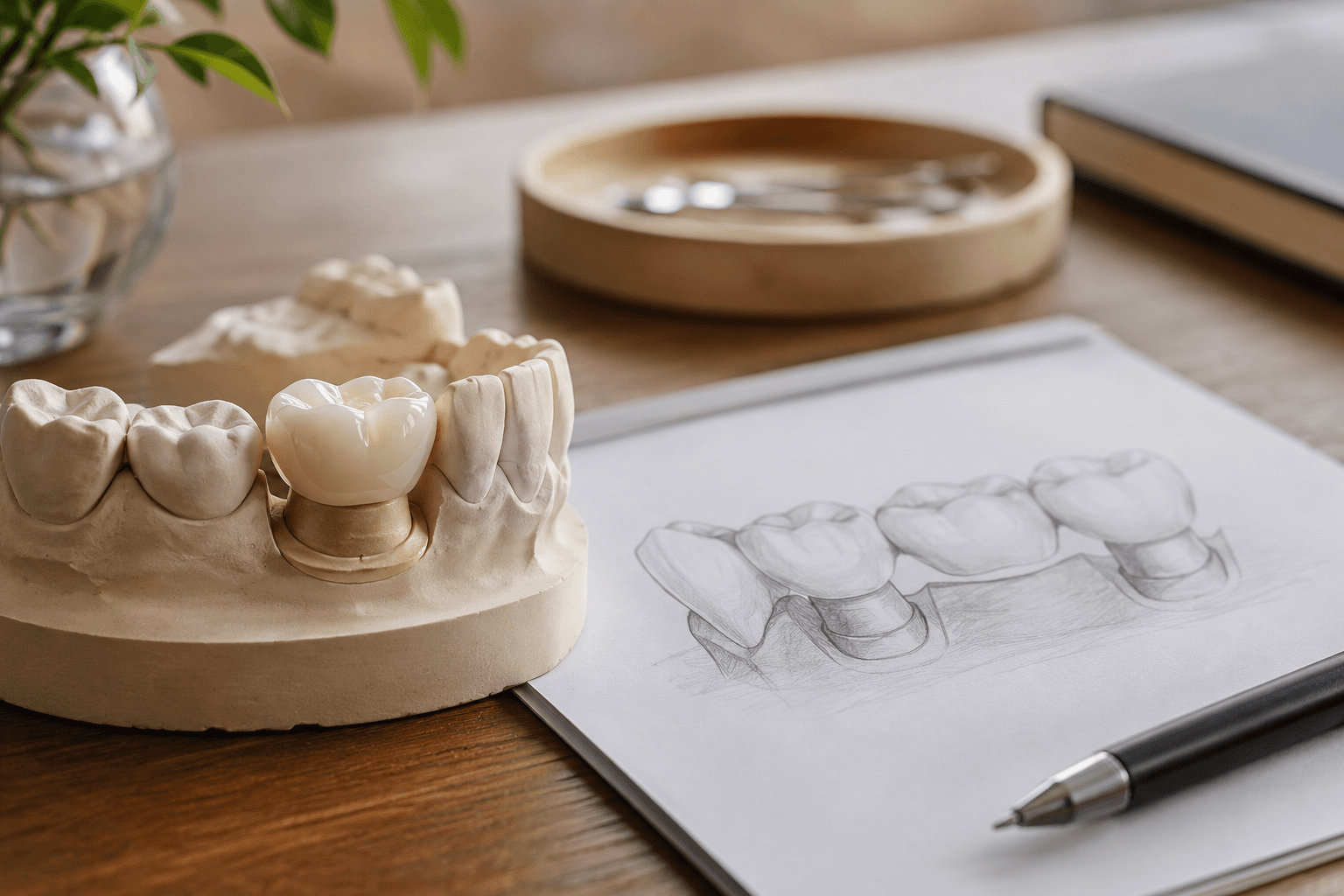
A crown is a tooth-shaped cap that covers a damaged tooth, restoring its strength, shape, and surface. A bridge replaces one or more missing teeth using the adjacent teeth as anchors, with the replacement tooth or teeth suspended between them. Both are made in a dental laboratory after the underlying teeth have been carefully prepared.
Crowns and bridges are not cosmetic in their first purpose. They restore function: a tooth that has lost too much structure to hold a filling, a tooth that has cracked, a tooth that has been root-treated and is now brittle, or a gap left by a tooth that cannot be saved. The cosmetic side comes alongside, not instead.
At our Mohali clinic we treat crown and bridge work as careful restorative dentistry, not as a quick fix. The fit, the bite, the shade, and the long-term suitability of the foundation tooth all matter, and we plan around them rather than around the appointment slot.
When a crown or bridge is needed
A crown is appropriate when a tooth has lost too much structure to be repaired with a filling alone. Common reasons include a large old filling that is failing, a tooth that has fractured, a tooth that has had root canal treatment and is now more brittle than a vital tooth, or a tooth that has worn down significantly. A crown protects the remaining structure and restores the bite force across the tooth.
A bridge is appropriate when a single tooth or a short run of teeth is missing, the teeth on either side of the gap are healthy and well-shaped enough to act as anchors, and the patient prefers a fixed solution to a removable one. In many cases a dental implant is a better long-term answer than a bridge, because it does not require the adjacent teeth to be prepared. We will say so when it is.
When it can wait, and when it should not
A tooth that needs a crown for protection (after root canal treatment, after a fracture, after a large failing filling) should usually have it placed within weeks to months, not years. The longer the unprotected tooth is in function, the higher the chance of a further crack that takes the tooth past saving. A small temporary filling holds the tooth in the short term; it is not a substitute for the crown.
A bridge to replace a missing tooth is less time-sensitive in the first weeks after extraction. The bone needs to settle before a final bridge is fitted. Where the gap will eventually receive an implant, the bridge decision waits until that decision is made. We will tell you what the right window is for your case.
How we approach crowns and bridges at our Mohali clinic
We perform crown and bridge work in-house at our Mohali clinic. The planning visit involves photographs, X-rays, a careful examination of the foundation tooth or teeth, a discussion of the materials available, and a written plan.
For full-mouth cases, for bridges that span several teeth, and for cases where the bite is being significantly rebuilt, Dr Aman coordinates with visiting prosthodontists who treat patients here at the clinic. Larger restorative cases benefit from a second pair of eyes at the planning stage and at the try-in.
We use ceramic and zirconia crowns for almost all front-tooth work because they sit beautifully with the natural tooth surface around them. Porcelain-fused-to-metal crowns still have a role in selected back-tooth cases where strength matters more than translucency. We will explain which material is suited to your tooth and why, rather than offering a one-size choice.
What to expect at your appointment
A crown is usually two visits about a week or two apart, plus a short fitting check after the final cementation. A bridge follows a similar sequence, with the lab time depending on the length of the bridge.
- A planning visit with examination, X-rays, and a written estimate.
- Preparation of the tooth or teeth under local anaesthetic, removing only the amount of structure needed to make room for the crown or bridge.
- An impression or a digital scan of the prepared teeth and the bite.
- A temporary crown or bridge cemented while the laboratory makes the final one.
- Try-in of the final crown or bridge to check the fit, the bite, and the shade.
- Cementation of the final crown or bridge, with a careful bite adjustment so it sits exactly right.
Some tenderness for a day or two after the preparation visit is normal, especially if the tooth was already sensitive. The temporary crown is not as strong as the final one; we ask you to avoid sticky food on that side and to call us if the temporary comes off before the final visit.
Common questions before treatment
Patients ask how long a crown lasts. A well-fitted crown on a healthy foundation tooth, with good home care and regular check-ups, can last fifteen to twenty years or longer. The most common reason a crown fails is decay around the edge where it meets the natural tooth, which is preventable with regular cleaning.
Patients also ask whether they should choose a bridge or an implant for a single missing tooth. In most cases, where the adjacent teeth are healthy, an implant is a better long-term answer because it does not require those teeth to be prepared. A bridge is a sensible choice when the adjacent teeth themselves need crowns anyway, or when an implant is not suitable for medical reasons.
A third question is whether all-ceramic crowns are as strong as the older porcelain-fused-to-metal ones. For most cases, the modern ceramics (zirconia in particular) are at least as strong, and they look more natural at the gum line. The choice is now more often about appearance than about strength.
A note on cost and timelines
Cost depends on the material (zirconia, layered ceramic, porcelain-fused-to-metal), the tooth involved, and whether any preparatory work (a build-up, a root canal, a bone or gum procedure) is needed first. We will give you a written estimate with each component costed separately.
For NRI patients planning crown or bridge work around a visit, please send X-rays in advance if you have them. We will set out a realistic two-visit plan, with the lab time built in, so the final restoration is fitted before you fly back.