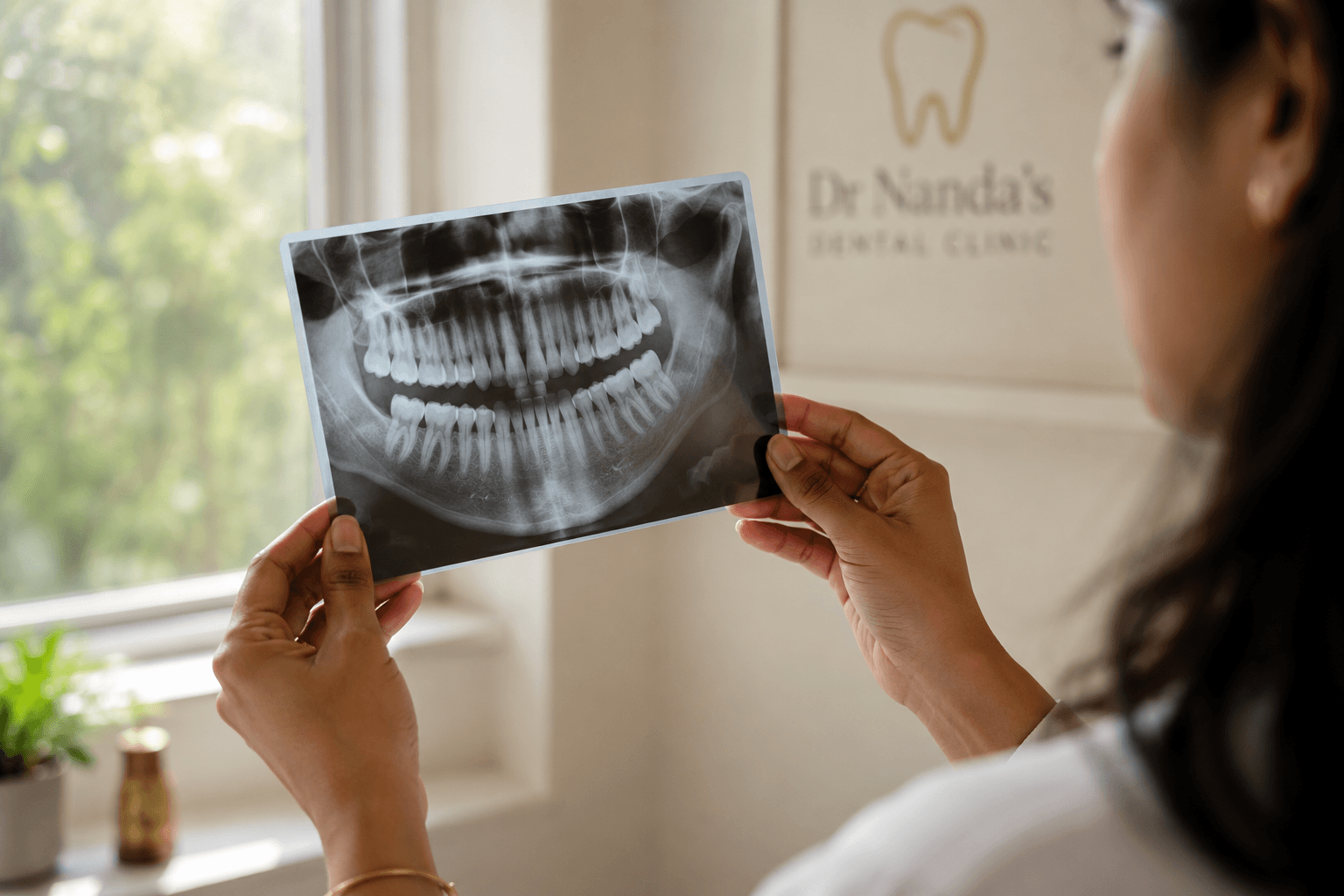
A root canal treatment saves a tooth whose inner nerve and blood supply are inflamed, infected, or dying. The inflamed tissue inside the tooth is carefully removed, the inside of the tooth is cleaned and shaped, and the space is sealed. The outside of the tooth remains. The tooth keeps its place in the mouth.
Root canal treatment has a reputation that does not match what it actually feels like today. For most patients, with modern instruments and good anaesthesia, the appointment is closer to a long filling than to anything dramatic. The pain people associate with root canals is usually the pain that brought them to the clinic in the first place, not the treatment itself.
At our Mohali clinic, we treat root canals carefully and without rushing. Where a case is straightforward we may complete it in one visit. Where it is not, we use two. The choice depends on the tooth, not on the schedule.
When a tooth needs a root canal
A tooth needs a root canal when its inner pulp has been compromised beyond what other treatments can repair. Common causes include deep decay that has reached the nerve, a fracture that exposes the pulp, repeated heavy work on the same tooth, or trauma from a knock or fall. The signs include lingering sensitivity to hot or cold, spontaneous throbbing pain, pain on biting, a tender swelling near the gum, or a tooth that has started to darken.
Not every painful tooth needs a root canal. Sometimes the answer is a filling, sometimes a deep clean, sometimes the tooth needs to be observed for a short period to see how it settles. We will only recommend root canal treatment when the evidence on the tooth and the X-ray points clearly to it. Where there is doubt, we say so and plan a follow-up.
When it can wait, and when it should not
A tooth with a low-grade ache that comes and goes, with no swelling and no fever, can sometimes wait a few days for an appointment. A tooth that was sensitive once after a hot drink and has been quiet since may not need any treatment at all. Watching a tooth for a short time is a legitimate clinical choice.
What should not wait: a tooth with constant throbbing pain, especially at night, a visible swelling on the gum or face, a bad taste from one part of the mouth, fever combined with tooth pain, or pain that has stopped you eating on that side. These suggest active infection, and the longer they are left, the more likely the tooth becomes harder to save.
How we approach root canal treatment at our Mohali clinic
We perform root canal treatments in-house at our Mohali clinic. The treatment uses rotary instruments, magnification, and rubber dam isolation. None of this is unusual in modern practice. What we add is the time to do each step properly.
For complex cases that benefit from specialist input, Dr Aman coordinates with visiting endodontists, root canal specialists, who treat patients here at the clinic. This keeps your treatment continuous, with one familiar team, one clinical record, and no shuttling between practices. You meet the specialist in the same chair you were assessed in.
After a root canal, most back teeth need a crown to protect what remains of the tooth structure. A root-treated tooth is more brittle than a vital one, and a crown distributes the bite force across the tooth instead of stressing the weakened walls. We will tell you whether your tooth needs a crown, and how soon.
What to expect at your appointment
A root canal appointment usually takes between sixty and ninety minutes per visit. Anterior teeth tend to be quicker. Lower molars, which often have curved canals, take longer.
- A full examination and an X-ray, sometimes two, to map the canals.
- Local anaesthetic. Modern anaesthesia is reliable; if the tooth has been sore, we may need a moment to confirm it is fully numb before we start.
- A rubber dam placed over the tooth to keep saliva and bacteria out of the canal during treatment.
- Access through the top of the tooth to reach the canals, removal of inflamed tissue, and careful cleaning and shaping of the inside of each canal.
- Filling the cleaned canals with a sealing material, usually gutta-percha, and placing a temporary filling on top.
- A review appointment to place the permanent filling and discuss the timing of the crown.
Afterwards the tooth may feel tender for a few days, particularly when you bite. This usually settles on its own. Take pain relief if you need to. If swelling appears, or pain worsens rather than fades, call us.
Common questions before treatment
Patients often ask whether a root canal is really better than just removing the tooth. Almost always, yes. A natural tooth, even root-treated and crowned, is better at holding its position, supporting the bite, and looking like itself than any replacement. We will only suggest extraction when the tooth genuinely cannot be saved.
Another common question is whether single-visit and multi-visit treatments differ in outcome. For most teeth, when there is no active swelling and the canal is straightforward, a single visit works well. For teeth with infection that needs to settle, or canals that need a medicament between visits, two appointments give a better result. We choose based on what your tooth needs, not what saves a half-hour.
People also ask how long a root-treated tooth lasts. A root canal followed by a properly fitted crown can give you many years from a tooth that would otherwise have been lost. The longevity depends mostly on the crown, the bite, and your gum health.
A note on cost and timelines
Cost depends on the tooth (front teeth have fewer canals than molars), whether the case is a first treatment or a re-treatment, and whether a crown is needed afterwards. We will give you a written estimate that covers the treatment and the crown separately, so you can plan in stages.
For NRI patients combining treatment with a visit home, root canals can usually be planned across one or two appointments. If a crown is needed, the lab work adds another week or so. Tell us your travel dates a few weeks before you arrive and we will work backwards from them.