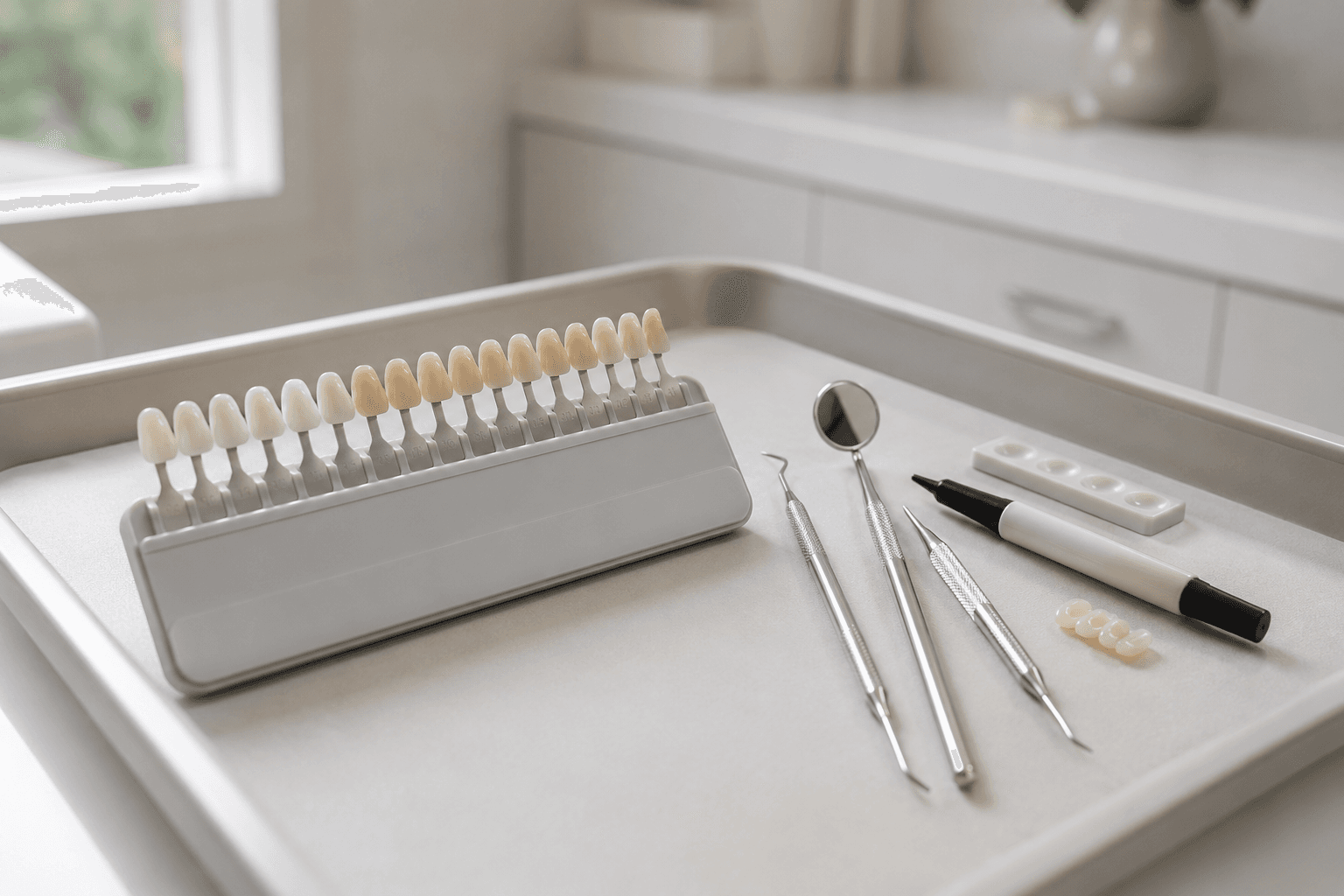
Veneers can change the appearance of teeth, but they should not be treated like a beauty filter for the mouth.
A veneer is a thin covering placed on the front surface of a tooth to improve shape, colour, proportion, or minor imperfections. In the right case, it can look natural and considered. In the wrong case, it can look artificial, feel wrong, or ask too much of a healthy tooth.
Veneers can help with selected chips, stains, gaps, worn edges, and shape concerns. They cannot fix active gum disease, poor oral hygiene, deep bite problems, untreated decay, or unrealistic expectations.
Good veneers begin with diagnosis and restraint, not a template.
What veneers are
Veneers are thin shells bonded to the visible front surface of teeth. They may be made from porcelain or composite resin, depending on the case and plan.
They are usually considered for front teeth, where appearance matters most. The dentist looks at the tooth shape, gumline, smile line, bite, lip movement, face, and existing tooth colour before recommending them.
A veneer is not simply a white layer. It changes how the tooth looks and sometimes how it functions in the bite.
That is why planning matters.
What veneers can do
Veneers may help with:
- Stained teeth that do not respond well to whitening
- Small chips on front teeth
- Minor gaps between teeth
- Uneven tooth shapes
- Worn front edges
- Mild size or proportion concerns
- Old composite repairs that no longer look natural
- Some surface defects in enamel
The goal should not be the brightest possible smile. The goal should be a smile that suits the person.
In a North Indian setting, especially around weddings and major family events, patients often want a visible improvement without looking artificial. That is a sensible expectation. The planning should protect it.
What veneers cannot do
Veneers are not the answer to every cosmetic concern.
They cannot:
- Treat active gum disease
- Make unhealthy teeth healthy
- Replace orthodontics in significant crowding or bite problems
- Fix untreated decay
- Stop grinding or clenching
- Work well if oral hygiene is poor
- Guarantee a permanent result
- Suit every face or every tooth shape
If veneers are placed over problems that should have been treated first, those problems may continue underneath or around them.
Cosmetic dentistry should never skip basic dental health.
Why veneers are a serious decision
Some veneers require removal of a small amount of enamel. Once enamel is removed, the decision is usually not fully reversible.
This does not make veneers bad. It makes them important.
Before choosing veneers, a patient should understand:
- How many teeth are involved
- Whether enamel needs to be removed
- Whether whitening should be done first
- Whether gum treatment is needed first
- Whether bite forces are safe
- Whether a night guard may be needed for grinding
- How the veneers will be maintained
- What may need repair or replacement later
A good cosmetic result is not only what it looks like on day one. It is how it ages.
Veneers, bonding, and whitening
Sometimes veneers are the right choice. Sometimes a more conservative option is better.
Whitening may be enough if the main concern is colour and the teeth are otherwise healthy. Bonding may be better for small chips or gaps when tooth cutting can be avoided. Orthodontic treatment may be better when the problem is tooth position. Gum treatment may be needed before any cosmetic work if the gumline is inflamed or uneven.
The best cosmetic plan often combines restraint with sequence. It asks what can be improved without overtreating.
When veneers may be worth considering
Veneers may be worth discussing if:
- You have front tooth chips or worn edges
- Teeth are deeply stained and whitening is unlikely to be enough
- Small gaps affect the smile
- Tooth shape or proportion feels uneven
- Previous bonding has failed or stains repeatedly
- The teeth and gums are otherwise healthy
- You understand the maintenance involved
The dentist should examine the mouth before deciding whether veneers are appropriate.
When to pause before veneers
It is sensible to pause if:
- Gums bleed regularly
- There is untreated decay
- Teeth are very sensitive
- You grind or clench heavily
- You want very white teeth that may not suit your face
- You are rushing for a wedding or event with too little time
- You are choosing veneers because of social media photos
- You have not discussed alternatives
A smile that looks natural usually comes from planning, not rushing.
What the dentist may check
Before recommending veneers, the dentist may check:
- Tooth health
- Gum health
- Bite and grinding signs
- Existing fillings
- Enamel thickness
- Smile line
- Lip movement
- Face shape and tooth proportions
- Shade expectations
- Photographs or mock-ups, if useful
- Whether whitening, bonding, or orthodontics should come first
The cosmetic question is never separate from the dental question.
What not to do
Do not choose a veneer shade that looks good only in a photograph.
Do not ask for identical teeth copied from someone else's smile.
Do not ignore bleeding gums before cosmetic work.
Do not rush irreversible treatment because a wedding date is close.
Do not assume veneers are maintenance-free.
Do not let social media decide what your face needs.
FAQs
What are veneers used for?
Veneers are used to improve the appearance of selected front teeth, including colour, shape, small chips, gaps, and surface defects.
Are veneers permanent?
Veneers are long-term restorations, but they are not permanent in the sense of lasting forever. They may need repair or replacement over time.
Are veneers reversible?
If enamel is removed, the treatment is usually not fully reversible. This is why planning and consent matter.
Can veneers fix crooked teeth?
They may help in very minor alignment concerns, but significant crowding or bite problems may need orthodontic treatment instead.
Do veneers damage teeth?
Well-planned veneers can be appropriate in selected cases. Poorly planned veneers or veneers placed on unhealthy teeth can create problems.
Should I whiten before veneers?
Often, whitening is considered before veneers so the final shade can be planned properly. The dentist will advise based on your teeth.
Can I get veneers before my wedding?
Possibly, but the timing must be realistic. Cosmetic dentistry around a wedding needs buffer time for planning, gum health, shade decisions, and adjustments.
Veneers can be beautiful when they are planned around a real person, not a template.
They can improve what bothers a patient, but they should not ignore tooth health, gum health, bite, or the natural character of the face.
At Dr Nanda's Dental Clinic in Mohali, cosmetic dentistry is approached slowly and honestly. If you are considering veneers, call or WhatsApp the clinic for a consultation that begins with the health of the teeth, not only the colour of the smile.