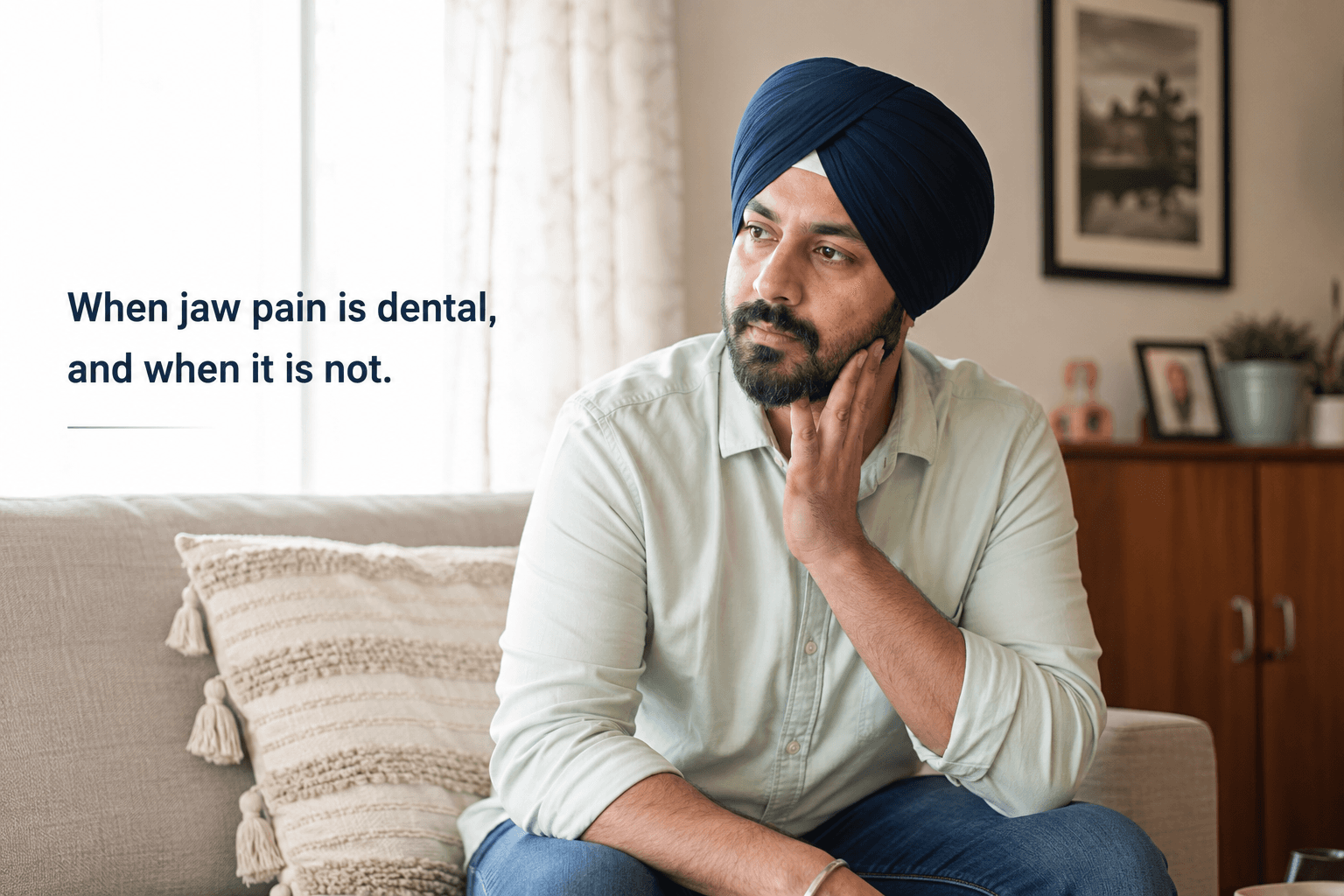
Jaw pain is confusing because it does not always feel like a tooth problem. It may sit near the ear, spread toward the temple, appear while chewing, or feel like tightness in the morning.
Sometimes jaw pain is dental. A decayed tooth, cracked tooth, gum infection, wisdom tooth, or abscess can refer pain into the jaw. Sometimes it is not mainly dental. It may come from the jaw joint, clenching, grinding, muscle strain, sinus pressure, or another medical cause.
The useful question is not, "Is this definitely a tooth?" The useful question is, "What pattern is the pain following?"
This article cannot diagnose jaw pain without an examination. It can help you notice the signs that make a dental cause more likely, and the signs that need prompt attention.
What jaw pain can mean
The jaw is close to many structures: teeth, gums, muscles, joints, sinuses, ears, and nerves. Pain from one area can feel as if it is coming from another.
A lower molar infection may feel like pain in the jaw. A jaw joint problem may feel like ear pain. Grinding can make the whole jaw feel tired. A wisdom tooth can cause soreness at the back of the mouth and difficulty opening.
That is why jaw pain needs a careful history, not only a quick look at the tooth that seems closest to it.
When jaw pain is more likely dental
Jaw pain may be dental when it is linked to one tooth or one side of the mouth.
Dental causes become more likely if you notice:
- Pain while biting or chewing
- A tooth that feels higher than the others
- Cold or hot sensitivity in one tooth
- A cracked, broken, or decayed tooth
- Swelling in the gum or face
- Bad taste, pus, or a boil on the gum
- Pain around a wisdom tooth
- Food getting stuck in the same area
- Pain that wakes you at night
A dental infection may not always look dramatic at first. Sometimes the first sign is a deep ache that seems to sit in the jaw rather than in the tooth.
When jaw pain may come from the joint or muscles
The jaw joint sits in front of the ear. It works every time you chew, speak, yawn, or clench.
Jaw joint or muscle pain may be more likely if you notice:
- Clicking or popping near the ear
- Pain while opening wide
- Difficulty opening the mouth fully
- Tightness in the morning
- Headaches around the temples
- Pain after chewing hard foods
- A habit of clenching during stress
- Worn or flattened teeth
- Tender jaw muscles
Many patients in busy work, study, or exam routines clench without realising it. The pain can feel dental even when the main source is muscle strain or joint overload.
When jaw pain may not be a dental problem
Some jaw pain needs medical attention rather than only dental care.
Pain may be linked to sinus trouble if it comes with blocked nose, facial pressure, or upper back-tooth soreness on both sides. Ear problems can also refer discomfort toward the jaw.
Very rarely, pain in the jaw may be part of a wider medical emergency, especially if it comes with chest pain, breathlessness, sweating, faintness, or pain spreading to the arm, shoulder, neck, or back. In that situation, do not wait for a dental appointment. Seek emergency medical care.
A dentist can help separate dental causes from non-dental causes, but some patterns must not be delayed.
When it can wait
Jaw pain may be watched briefly if:
- It is mild
- It appeared after chewing something hard
- It feels like muscle tiredness
- There is no tooth sensitivity
- There is no swelling
- You can open and close the mouth normally
- It is improving with rest and softer food
During this time, avoid chewing from the painful side, avoid very hard foods, and notice whether the pain is improving or repeating.
Waiting should be careful. If the same jaw pain keeps returning, arrange an examination.
When to call a dentist
Call a dentist if jaw pain is persistent, worsening, or linked to a tooth.
You should arrange a dental visit if:
- The jaw pain lasts more than a short period
- There is pain on biting
- One tooth feels sensitive or painful
- There is swelling in the gum, jaw, or face
- The pain is near a wisdom tooth
- You cannot open your mouth properly
- The jaw clicks painfully or locks
- You wake with jaw tightness often
- There is a bad taste, pus, or fever
- Pain follows a fall or injury
Prompt examination is especially important if jaw pain comes with swelling, fever, difficulty swallowing, or difficulty breathing.
What the dentist may check
The dentist may check both teeth and jaw function.
The examination may include:
- Checking teeth for decay, cracks, and old fillings
- Testing biting pressure
- Checking gum swelling or infection
- Looking at wisdom teeth
- Assessing jaw opening and movement
- Feeling the jaw muscles for tenderness
- Listening for joint clicking or locking
- Checking signs of grinding or clenching
- Taking X-rays if needed
The aim is to avoid treating the wrong thing. A tooth problem, a joint problem, and a muscle problem need different care.
Possible treatment options
Treatment depends on the cause.
A dental cavity may need a filling. A cracked or weakened tooth may need protection. A nerve infection may need root canal treatment. A wisdom tooth problem may need cleaning, monitoring, or removal depending on the case.
If the pain is from clenching or grinding, the plan may include habit awareness, bite assessment, a night guard in selected cases, or referral if the joint problem is complex. If the pain appears medical rather than dental, the dentist may advise seeing a physician or specialist.
Good care starts by locating the source.
What not to do
Do not keep chewing hard foods to test whether the jaw still hurts.
Do not assume ear-area pain is always an ear problem, or always a tooth problem.
Do not use leftover antibiotics for jaw pain. Infection needs diagnosis, and many jaw pains are not infections.
Do not ignore swelling, fever, difficulty opening the mouth, or difficulty swallowing.
Do not delay emergency medical care if jaw pain comes with chest pain, breathlessness, sweating, or pain spreading to the arm, shoulder, neck, or back.
FAQs
Can jaw pain come from a tooth?
Yes. A decayed, cracked, infected, or inflamed tooth can cause pain that feels as if it is in the jaw.
Why does my jaw hurt near the ear?
Pain near the ear may come from the jaw joint, chewing muscles, an ear problem, or a dental problem. The pattern of pain helps decide what to check first.
Can grinding cause jaw pain?
Yes. Clenching or grinding can overload the jaw muscles and joints. Many people notice morning tightness, headaches, or worn teeth.
Is jaw clicking serious?
Not always. A painless click may not need urgent treatment. Painful clicking, locking, limited opening, or worsening symptoms should be assessed.
Can wisdom teeth cause jaw pain?
Yes. Wisdom teeth can cause pain at the back of the jaw, gum swelling, difficulty cleaning, or trouble opening if inflammation is present.
When is jaw pain urgent?
Jaw pain with facial swelling, fever, difficulty swallowing, difficulty breathing, trauma, or severe worsening pain needs prompt care. Jaw pain with chest pain or breathlessness needs emergency medical attention.
Should I see a dentist or doctor for jaw pain?
If the pain is linked to teeth, chewing, gums, or jaw movement, a dentist is a sensible first step. If there are general medical symptoms, chest symptoms, or ear or sinus symptoms, medical care may also be needed.
Jaw pain should not be guessed at for too long.
Sometimes it is a tooth asking for treatment. Sometimes it is the jaw joint asking for rest and correction. Sometimes it is a sign that another medical cause should be considered.
At Dr Nanda's Dental Clinic in Mohali, jaw pain is assessed by looking at teeth, gums, bite, muscles, and the jaw joint together. If your jaw pain is recurring, worsening, or linked to chewing, call or WhatsApp the clinic for a calm examination.