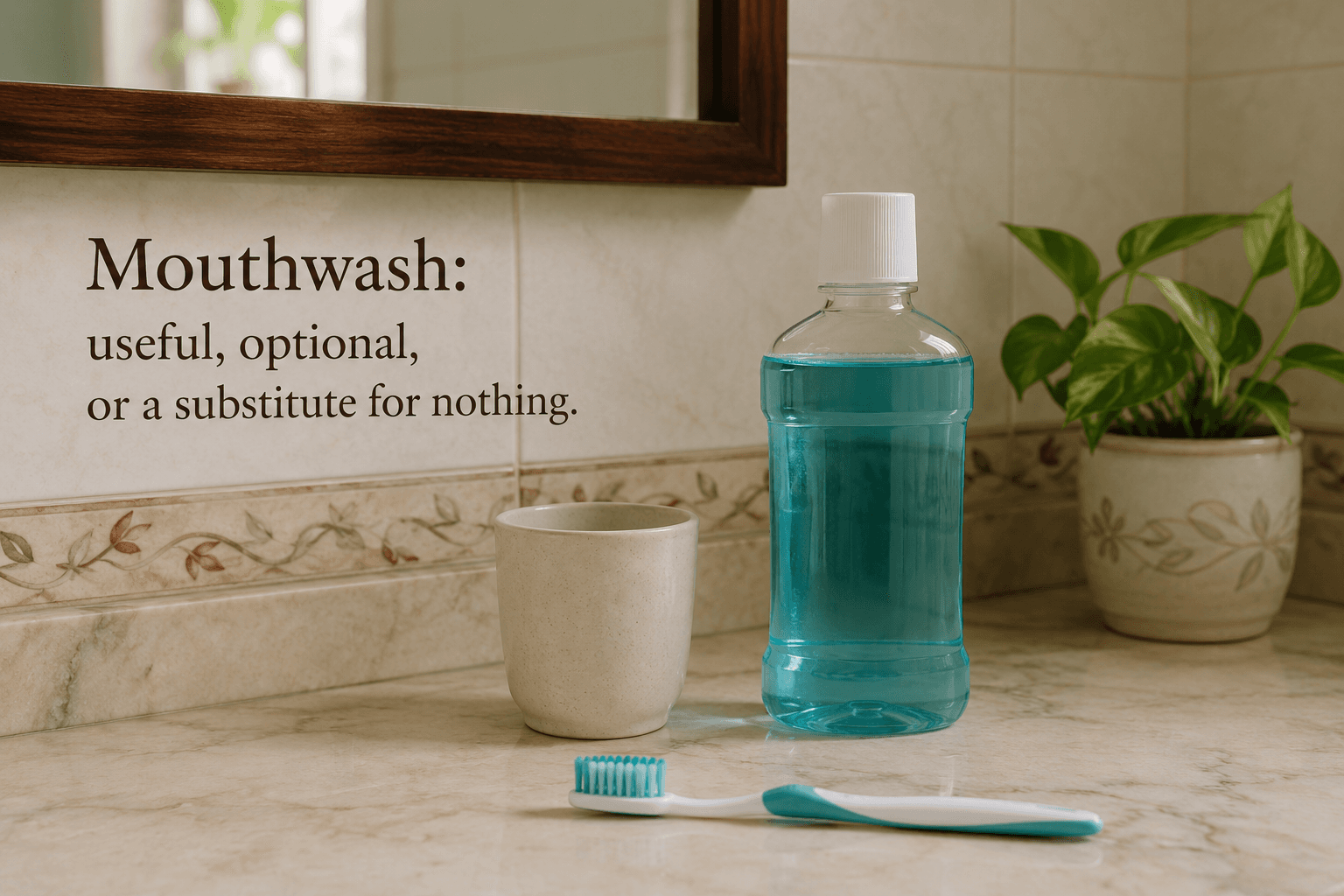
Mouthwash feels like it should solve more than it does. It tastes strong, leaves the mouth fresh, and gives the impression that the job is finished.
Sometimes mouthwash is useful. A fluoride rinse may help certain patients at higher risk of decay. An antiseptic rinse may be advised for a short period in selected gum or healing situations. A dry-mouth rinse may support comfort.
But mouthwash is not a substitute for brushing, cleaning between teeth, scaling, filling a cavity, treating gum disease, or finding the cause of bad breath.
Freshness is not the same as health.
What mouthwash can do
Different mouthwashes do different things.
Some contain fluoride to help protect enamel. Some are designed to reduce bacteria for a short period. Some focus on breath. Some are alcohol-free and gentler for dry or sensitive mouths. Some are prescribed or specifically advised after dental procedures.
A mouthwash can support a dental routine when used for the right reason. It is most useful when it is part of a plan, not a way to avoid one.
What mouthwash cannot do
Mouthwash cannot physically remove plaque the way brushing and interdental cleaning can.
It cannot remove tartar once plaque has hardened. It cannot repair decay. It cannot clean under a faulty crown or bridge. It cannot fix food trapping. It cannot treat an abscess. It cannot make gum disease disappear if tartar and deep gum pockets are present.
This is why a patient can use mouthwash daily and still have bleeding gums, bad breath, or cavities.
The mouth feels cleaner, but the cause remains.
Bad breath and mouthwash
Bad breath is one of the main reasons people use mouthwash.
If bad breath is occasional after food, fasting, tea, coffee, onions, garlic, or dehydration, a simple rinse may help temporarily. But persistent bad breath usually has a cause.
Common dental causes include:
- Plaque and tartar
- Gum disease
- Food trapped between teeth
- Cavities
- A coated tongue
- Dry mouth
- Old dental work that traps food
- Dentures that are not cleaned properly
Mouthwash may mask the smell for a while. It does not diagnose the reason.
Gum health and mouthwash
Some patients with gum inflammation are advised to use a specific mouthwash for a limited period.
This can be helpful, but it should not replace cleaning. If tartar is present, professional scaling is needed. If gum disease is advanced, deeper care may be required.
Long-term self-use of strong antiseptic rinses is not a good plan unless advised. Some can stain teeth, alter taste, or irritate the mouth when used incorrectly.
If gums bleed regularly, the first question is not which mouthwash to buy. The first question is why the gums are bleeding.
Fluoride mouthwash
A fluoride mouthwash may be useful for some patients, especially those at higher risk of decay.
This may include patients with frequent cavities, braces, dry mouth, gum recession, or difficulty cleaning certain areas. Timing matters because rinsing immediately after brushing may wash away concentrated toothpaste fluoride. A dentist can explain how to use it sensibly.
Not every patient needs a fluoride mouthwash. Many people need better brushing and interdental cleaning more than another product.
Alcohol-based mouthwash and dry mouth
Some mouthwashes contain alcohol. They may feel strong and clean, but they can be drying or irritating for some people.
If you already have dry mouth, burning, ulcers, sensitivity, or mouth soreness, choose products carefully and ask a dentist. A harsh rinse can make a sensitive mouth feel worse.
A comfortable mouthwash is not always the strongest one.
When it can wait
If you use mouthwash occasionally, have no pain, no bleeding gums, no persistent bad breath, and no dry mouth, it can usually be discussed at your next routine visit.
Bring the bottle or take a photo of the label if you want advice.
When to call a dentist
Call a dentist if:
- Bad breath persists despite brushing
- Gums bleed regularly
- There is swelling or pus near a tooth
- Food gets trapped repeatedly
- Mouthwash burns or causes soreness
- Dry mouth is persistent
- You have ulcers that do not heal
- A child is using adult mouthwash unsupervised
- You rely on mouthwash because brushing is painful
Persistent symptoms need examination, not only freshness.
What the dentist may check
The dentist may check:
- Plaque and tartar
- Gum pockets and bleeding
- Cavities
- Food traps
- Tongue coating
- Dry mouth
- Dentures, crowns, bridges, implants, or braces
- Whether a mouthwash is appropriate
- Whether the rinse should be short-term or regular
The aim is to match the product to the reason.
What not to do
Do not use mouthwash instead of brushing.
Do not use mouthwash instead of cleaning between teeth.
Do not use strong antiseptic rinses for months without advice.
Do not ignore bad breath that keeps returning.
Do not assume a burning feeling means the mouthwash is working.
Do not let children use adult mouthwash without guidance.
Do not use mouthwash to delay treatment for toothache, swelling, or bleeding gums.
FAQs
Is mouthwash necessary?
Not for everyone. Some patients benefit from it, but many need better brushing and interdental cleaning more than mouthwash.
Can mouthwash stop bad breath?
It may reduce smell temporarily. Persistent bad breath needs the cause checked, especially plaque, tartar, gum disease, cavities, dry mouth, or food trapping.
Can mouthwash replace flossing?
No. Mouthwash cannot physically clean between teeth the way floss or interdental brushes can.
Is alcohol-free mouthwash better?
It may be better for patients with dry mouth, burning, ulcers, or sensitivity. The right product depends on the reason for using it.
Should I use mouthwash after brushing?
Not always. Some rinses may wash away toothpaste fluoride if used immediately after brushing. Ask your dentist about timing.
Can mouthwash cure bleeding gums?
It may help selected cases temporarily, but bleeding gums usually need proper cleaning, diagnosis, and sometimes scaling.
Is mouthwash safe for children?
Children should use mouthwash only when age-appropriate and advised. Young children may swallow it, so guidance matters.
Mouthwash can be useful. It can also create a false sense that the mouth is clean when the problem is still there.
Use it for the right reason, not as a substitute for the basics.
At Dr Nanda's Dental Clinic in Mohali, mouthwash advice is given only after understanding the mouth in front of us. If you are using mouthwash for bad breath, bleeding gums, dry mouth, or soreness that keeps returning, call or WhatsApp the clinic. The cause is worth finding.