Many parents in Mohali and Chandigarh Tricity bring a child to the dentist only when there is pain. It is understandable. If the child is eating, smiling, and sleeping well, the teeth can seem fine.
But a child's first dental visit should ideally happen much earlier: around the time the first tooth appears, or by the child's first birthday. For families who have missed that window, the next best time is now.
A first visit is usually not about treatment. It is about checking growth, guiding parents, preventing decay, and helping the child learn that the dentist is a safe place.
Why the first dental visit should be early
Baby teeth can develop problems soon after they appear. Early decay, feeding habits, brushing difficulty, enamel issues, thumb-sucking, mouth breathing, and injury risks can all be noticed early.
An early visit gives parents practical guidance before there is pain.
It also gives the child a memory of the dentist that is not linked to drilling, injections, swelling, or emergency treatment. A calm first visit can make later care easier.
What happens at a child's first dental visit
The exact appointment depends on the child's age and comfort.
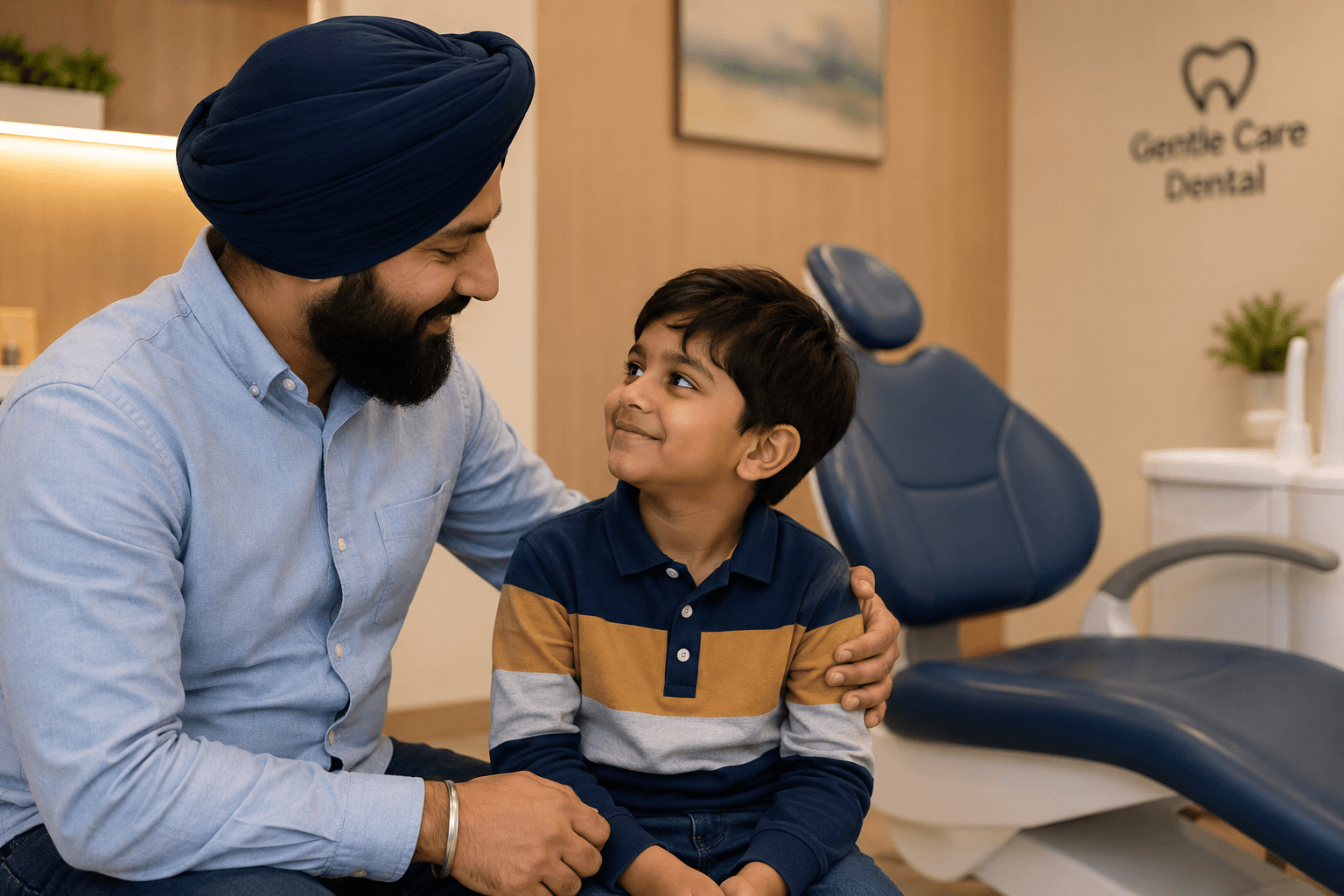
For a very young child, the visit may be short. The dentist may examine the teeth and gums while the child sits with a parent. The dentist may count the teeth, check for early decay, look at the bite, and discuss brushing and diet.
For an older child, the visit may include a chair examination, gentle cleaning if needed, and more detailed guidance.
The dentist may check:
- Which teeth have come in
- Tooth alignment and bite development
- Early cavities or enamel defects
- Gum health
- Tongue, lips, and oral tissues
- Brushing routine
- Bottle, milk, sweet, and snacking habits
- Thumb-sucking or dummy habits
- Any history of pain or injury
The appointment should not feel like an interrogation. It should feel like a parent and dentist planning care together.
How to prepare your child
Keep the explanation simple.
You can say: "The dentist will count your teeth and see how strong they are."
Avoid saying things like:
- It will not hurt, if you are not sure what will be needed
- Do not be scared, which introduces the idea that there is something to fear
- If you eat sweets, the dentist will give an injection
- Nothing will happen, if the dentist may need to examine carefully
Children listen to tone more than detail. If the parent sounds calm, the child usually starts calmer.
What parents should mention
Before the visit, think about:
- When the first tooth appeared
- Whether the child complains of pain
- Whether the child avoids cold foods
- Whether food gets stuck
- Brushing routine and toothpaste used
- Bottle feeding, night milk, or sweet drinks
- Snacking habits
- Thumb-sucking or dummy use
- Any fall or tooth injury
- Medical conditions, medicines, allergies, or special needs
If there is a visible problem, a clear photo can help explain what you noticed, but it does not replace the visit.
When a routine visit is enough
If your child is comfortable, eating well, sleeping well, and has no visible dental problem, the visit can usually be planned as a routine appointment.
It should still be planned. Waiting until pain appears makes the first visit harder for the child.
A routine first dental visit is one of the simplest ways to prevent dental fear.
When to call a children's dentist sooner
Call a dentist sooner if your child has:
- Tooth pain
- Swelling near the gum or face
- A visible cavity
- A broken or chipped tooth
- A tooth injury after a fall
- Bleeding gums
- Bad breath with food trapping
- Difficulty chewing
- Cold sensitivity that repeats
- A baby tooth that looks dark after trauma
- Night pain or disturbed sleep
If there is swelling, fever, trauma, or severe pain, do not wait for a routine check.
What the dentist may advise
Depending on the child's age and teeth, the dentist may advise brushing technique, fluoride toothpaste amount, parent-assisted brushing, diet and snack changes, night milk guidance, monitoring of eruption and bite, cleaning if needed, fluoride application if appropriate, and a review schedule based on the child's risk.
Not every child needs treatment. Many children need parents to receive the right instructions early.
The parent's role
For young children, oral care is not the child's responsibility alone.
A child may want to brush independently, but most young children do not have the hand control to clean thoroughly. Parents usually need to help or supervise until the child is old enough to do it properly.
This is not about being strict. It is about making brushing a normal family routine, like bathing or bedtime.
What not to do
Do not wait for pain before the first visit.
Do not use the dentist as a threat.
Do not brush aggressively if the child resists.
Do not let a child sleep with milk, juice, or sweet drinks coating the teeth unless there is a specific medical reason.
Do not ignore decay in milk teeth because they will fall out later.
FAQs
When should my child first see a dentist?
Ideally, around the time the first tooth appears, or by the first birthday. If your child is older and has not yet visited, book a calm first visit now.
Is the first dental visit painful?
A routine first visit is usually a gentle examination. The dentist looks at the teeth, gums, bite, and habits. Treatment is only discussed if a problem is found.
What if my child cries at the dentist?
Crying is common, especially in young children. A gentle dentist will not treat fear as misbehaviour. The first aim is to make the child feel safe enough to be examined.
Should I prepare my child before the visit?
Yes, but simply. Say the dentist will count the teeth and help keep them strong. Avoid frightening words and avoid making promises you cannot control.
Do milk teeth need fillings?
Sometimes, yes. If a milk tooth has decay that can cause pain, infection, or affect eating, it may need treatment. The dentist will explain the options.
How often should children visit the dentist?
It depends on the child's risk, age, habits, and dental findings. Some children need more frequent review than others.
Can I bring my child just to get used to the clinic?
Yes. A familiar, low-pressure visit can be helpful, especially for anxious children.
A child's first dental visit should not be remembered as a crisis.
It should be simple: count the teeth, check the mouth, guide the parents, and let the child leave feeling safe. That is how trust begins.
At Dr Nanda's Dental Clinic in Mohali, children's dental visits are approached with patience and plain explanation. If your child has never seen a dentist, or if you are unsure whether it is time, call or WhatsApp the clinic. The first visit can be gentle, even when the parent has waited longer than planned.